
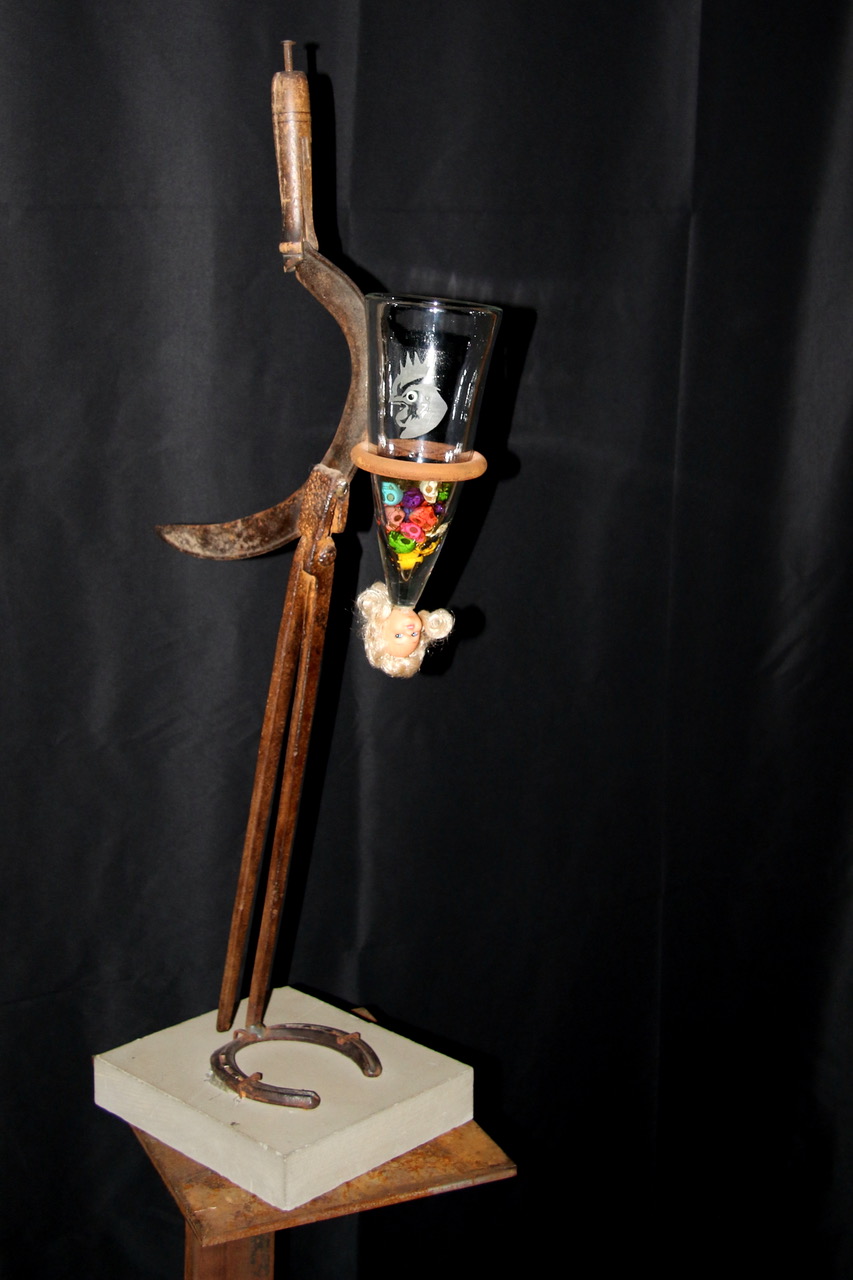
Cereal Killer, a sculpture by Rich Stewart. Photo: Rich Stewart.
The hand sickle came first. Rich Stewart wanted it to give Cereal Killer a late-1800s Western sense, a starting point for a sculpture in his manifest destiny series that would eventually bring together forge tongs, a horseshoe, glass and an upside-down doll’s head.
“That was the starting point, but my process is slow motion chaos,” Stewart wrote in an email interview.
Stewart, whose work appears at Raw Metal Works, makes components, sets them aside and returns to them as his thinking changes. Putting a piece together doesn’t necessarily tell him that it’s finished.
“I put it all together and then let it sit somewhere where I walk by it often for either days or weeks,” he wrote.
For Cereal Killer, that time revealed a gap between the Western imagery and what Stewart wanted to say about westward expansion. The tools had brought an era into the piece, but he wanted it to address the people harmed by that expansion.
He credits Italo Scanga’s cone holder series as an initial inspiration and describes the work of the De La Torre brothers, together with visits to Mexico, as influences on his decision to add multicolored skulls inside the cone. In Stewart’s account, the skulls connect the sculpture to the dead.
The doll’s head brings a different uncertainty. “Not really sure why the doll head ended up on the piece, but it felt important at the time and still does,” he wrote.
He associates it with commercial interests and marketing, and with a silliness that makes the work’s violence more bearable. The title holds grain production and killing together in a single pun.
Materials can interrupt his intentions before he reaches those meanings. Stewart describes castings that develop voids or unexpected textures, fabricated metal that requires compromises to stand and finishes that behave differently during application.
“Glass taught me to embrace mistakes and that, I believe, leads me to better work,” he wrote.
That willingness to let the object change also shapes his account of storytelling. Some pieces begin with a story; with others, he has to look inward after someone asks what the sculpture means.
“I make the work that I need to make,” Stewart wrote. “I think of that as punk.”
In Cereal Killer, he traces the story back to the hand sickle’s use in farming, then follows the forge tongs into industrial production and weapons. These are Stewart’s associations with the objects, and their ability to sustain life sits beside his concern about the violence of expansion.
“So in some sense the hand sickle both gave life and took life away,” he wrote.
The piece’s humor doesn’t settle that concern. Stewart ends his account by asking, “What is our moral obligation?”
Cereal Killer gives him an object to keep that question in view. The sickle starts the story, the later additions complicate it, and the sculpture can keep asking something of the person who walks past.

Be First to Comment