
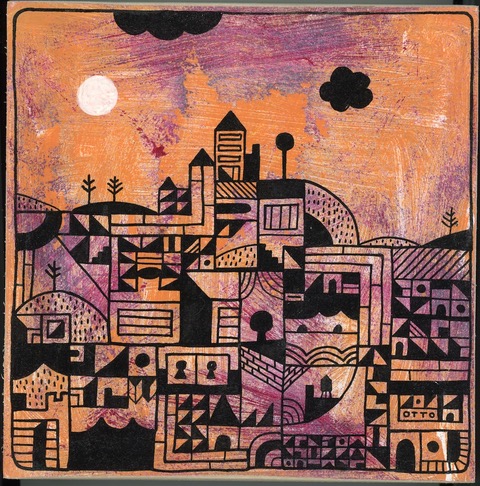
Featured photograph: Nate Otto, “City by Moonlight,” October 2026, 8 × 8 inches. Photo: Nate Otto.
Nate Otto recalls starting “City by Moonlight” with the buildings in its middle. The recent painting then moved in a direction he hadn’t planned, an example of how an imagined city develops through decisions made while he works.
“Every mark is a decision,” Otto wrote in an email interview.
“Sometimes I’ll start a piece with an image in mind, but that idea will change as I go and make decisions,” he wrote.
Otto’s paintings take Chicago as their source without requiring the buildings to depict particular places. He has lived in the city for most of his life and describes cities as his point of reference for the world.
“My imagined buildings and cityscapes are the language I use to express that vision, and as Chicago has been my home for most of my life, that expression naturally reflects this city,” Otto wrote.
“It’s a city, a densely populated place, and buildings all crammed up together is how the city manifests in my imagination,” he wrote.
Those buildings are also shapes and colors that he can adjust as a painting develops. A patch of sky, a cloud or a change in perspective can interrupt their density.
“It’s not a contrived thing. It just happens,” he wrote.
“City by Moonlight” became an example of that process because it landed somewhere different from his initial intention. Otto describes following his own intuition as a different path from thinking about what someone else wants in a commission.
People remain part of how he imagines the buildings even when they don’t appear in the image. He connects the clusters of faces he sometimes paints with the inhabitants of those cityscapes.
“Where there are buildings, there are people and there is vitality. Even if they aren’t seen, they are there,” Otto wrote.
The possibility of another decision also makes finishing a painting provisional. Otto can notice something later and return to a piece he has already considered complete.
“There are pieces that I have finished four or five times,” he wrote.
“I probably wouldn’t go so far as to work on something that I had already sold, but if it’s in my studio, it’s never really finished,” Otto wrote.

Be First to Comment