
By Daniel Johanson
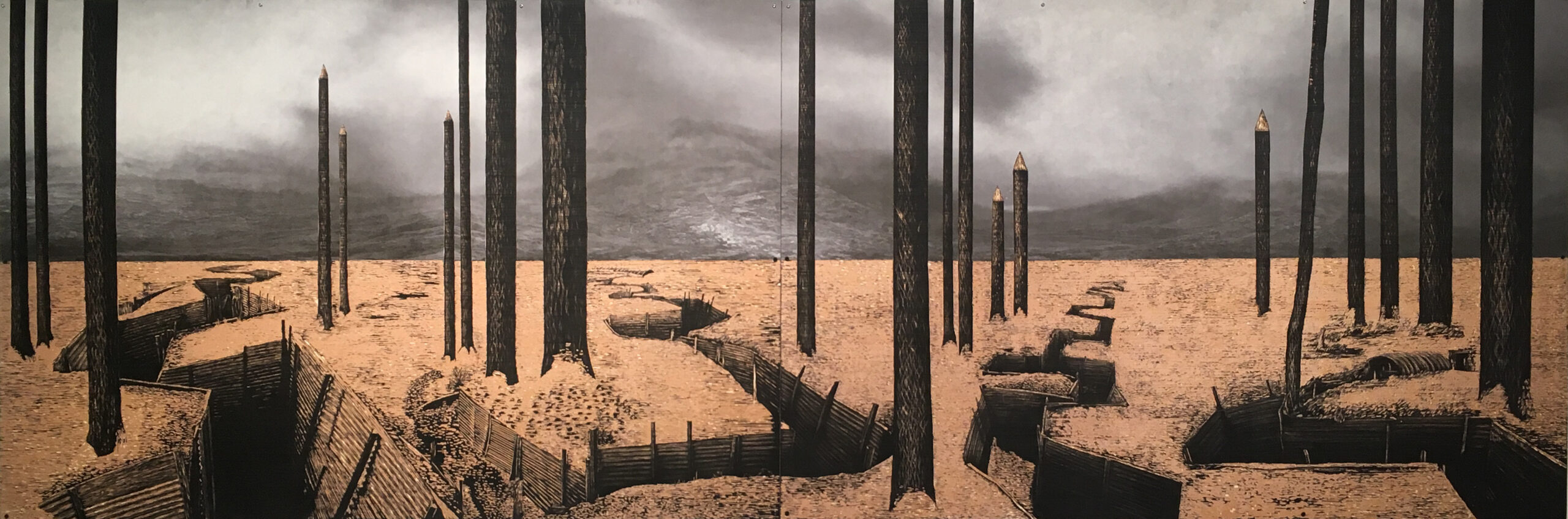
Agata Derda, Dark Roads, woodcut panel with Digital Print Chine Colle, 48 inches high by 120 inches wide, 2019. Artwork and image courtesy of Agata Derda.
Trees cut back when sick or dying stayed with Agata Derda: trunks with branches amputated at the ends. Those forms brought the human figure to mind and became one source for “Dark Roads,” her series combining linocut or woodcarving in the foreground with photographic imagery behind it.
“Seeing them helped me think about the vulnerability and endurance of living beings without representing a person directly,” Derda wrote in an email interview.
Derda connects trees and humans through their search for energy, the roots they establish and their capacity to support other life. In the altered Toronto trees she described, she also saw the effect of human violence on a living form.
“I became interested in how something made or altered by people can suggest human presence, intention, and action even in the absence of the body itself,” she wrote of concerns extending back to graduate study.
The human presence in “Dark Roads” also comes through the physical work of carving. Derda spends hours close to the material, building an image through accumulated cuts.
“Every cut becomes personal because the resulting image is filtered through the printmaker's own vision of the world,” she wrote.
The photographic landscapes offer a different kind of recognition. Derda constructs them from multiple images, so their apparent documentary quality doesn’t mean they record a place that actually existed.
“I think of them as stages for the foreground actors: my carved constructions, often resembling trees or other forms,” Derda wrote.
“This is why I use bold black carved forms against soft grey photographic landscapes,” she wrote.
The quieter background gives those constructions somewhere to act without competing for attention. Derda explores compositions through thumbnail sketches and tends to choose closed compositions, keeping the important action within the image’s boundaries.
“I want the composition to suggest that something has happened and reached a conclusion, even if the viewer doesn't know exactly what that event was,” she wrote.
Scale changes who can gather around that event. Derda describes smaller images as intimate encounters, usually for one person close to the work, while larger pieces can accommodate a shared experience.
She usually imagines that encounter in a gallery. When she controls the space, she prefers dim lighting with spotlights on the prints, and she has sometimes added wind sounds to suggest an open space.
“Again, I think of the work in theatrical terms: I want my actors to be illuminated and noticed,” she wrote.
Derda says she is gradually moving toward work focused more on sculpture, while print continues to have a special place in her practice. In “Dark Roads,” the carved construction already carries the weight of a figure, with a landscape and a frame determining where it can be encountered.
“As artists, we make many decisions to shape how our work is presented and perceived, but our control over interpretation is always limited,” Derda wrote.
