
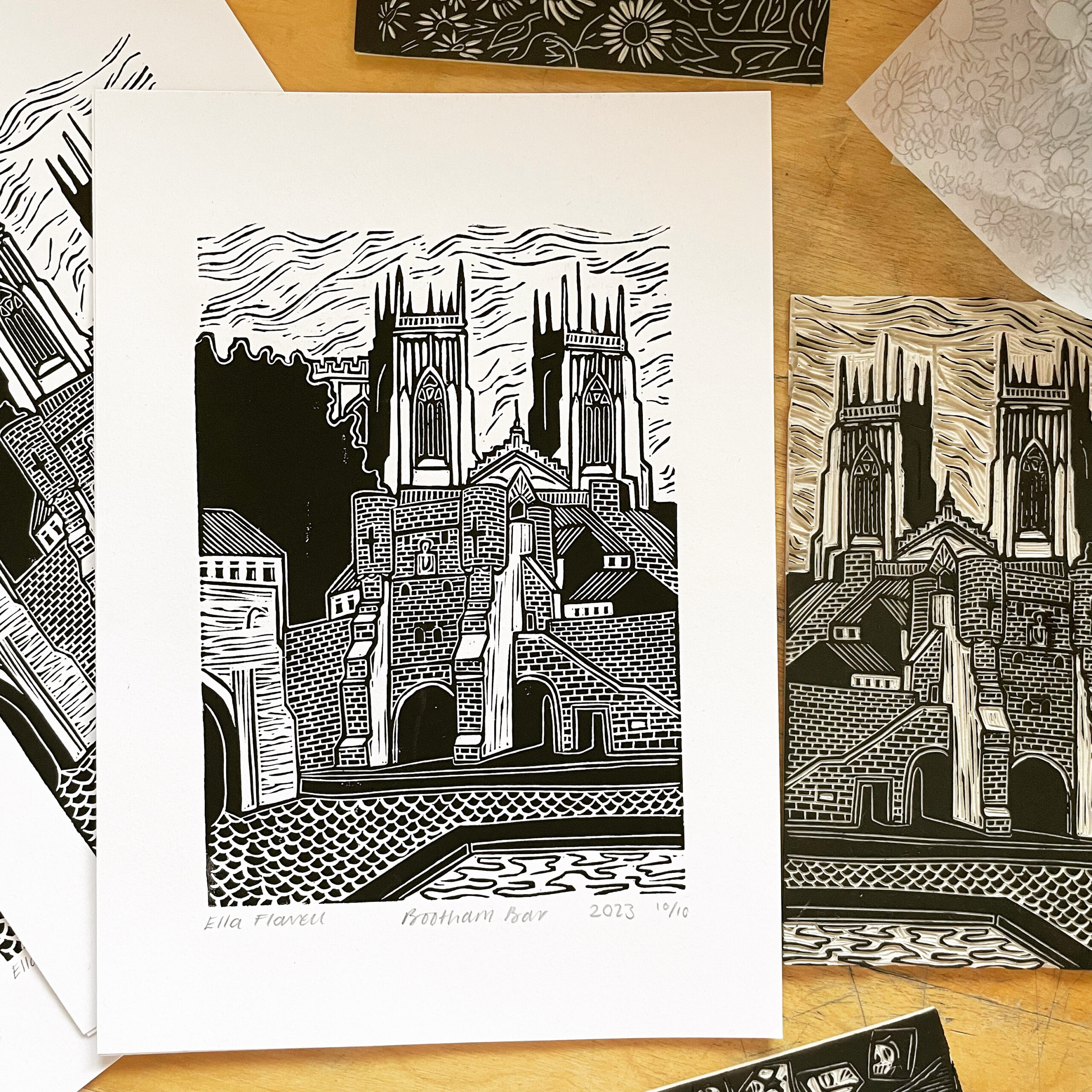
York Minster from Bootham Bar Linocut. Photo: Ella Flavell.
By Daniel Johanson
In her linocuts, a church beyond a traffic junction can become more prominent because of the memory it holds.
“I usually work from a really basic, pared-back sketch with minimal detail, just a basic mapping out of the space,” Ella Flavell wrote in an email interview.
The details arrive as she carves. For the printmaker behind Burin & Plate, that space can begin with a familiar road junction, a traffic island or a housing estate around Dudley in England’s West Midlands.
Flavell has lived in the area for almost all her life and wants to share the heritage and beauty she finds in its industrial landscape. Alongside recognizable landmarks, she is interested in places that local people notice because they know them.
“In my print ‘Home Thoughts’ I collage together places of personal significance that make up my local area and are the places I picture when thinking about home, including road junctions, traffic islands, and housing estates,” Flavell wrote.
One scene includes a junction where she is often stuck in traffic. A church stands on a hill in the distance, visible only at certain times of year because of the trees around it. In the print, she made it more prominent to reflect how firmly that view remains in her memory.
The resulting arrangement follows what stays with her about a place. Patterns and graphic contrast let her adjust its visual hierarchy while keeping an atmosphere she associates with remembering it.
“I want to find a way to depict the experience of a place as well as what is visually there too, including the way you move through the space,” Flavell wrote.
Texture belongs to that experience. She names rough concrete, cobbles and the wood grain of old buildings as parts of how a place feels, giving the carved lines work to do beyond describing a building’s outline.
During carving, she usually paints the block in a contrasting color. That helps her judge the balance as detail emerges, including where the eye might need somewhere to rest.
The block still has a surprise to offer when it becomes a print. Reversing the image can change her sense of perspective and the overall composition.
“Accounting for the reversal of the image during the printmaking process can sometimes play tricks on you regarding perspective and the overall composition, so seeing the print the ‘right’ way round can look surprisingly different from the original carving,” Flavell wrote.
She remembers Cloud Study as a particularly difficult carve, an experiment in different ways of depicting clouds. Seeing it printed brought satisfaction and lessons she could carry into later work.
A minimal sketch leaves room for those discoveries. The place she starts with takes shape through memory and carving, then changes again when she finally sees the printed image.
