
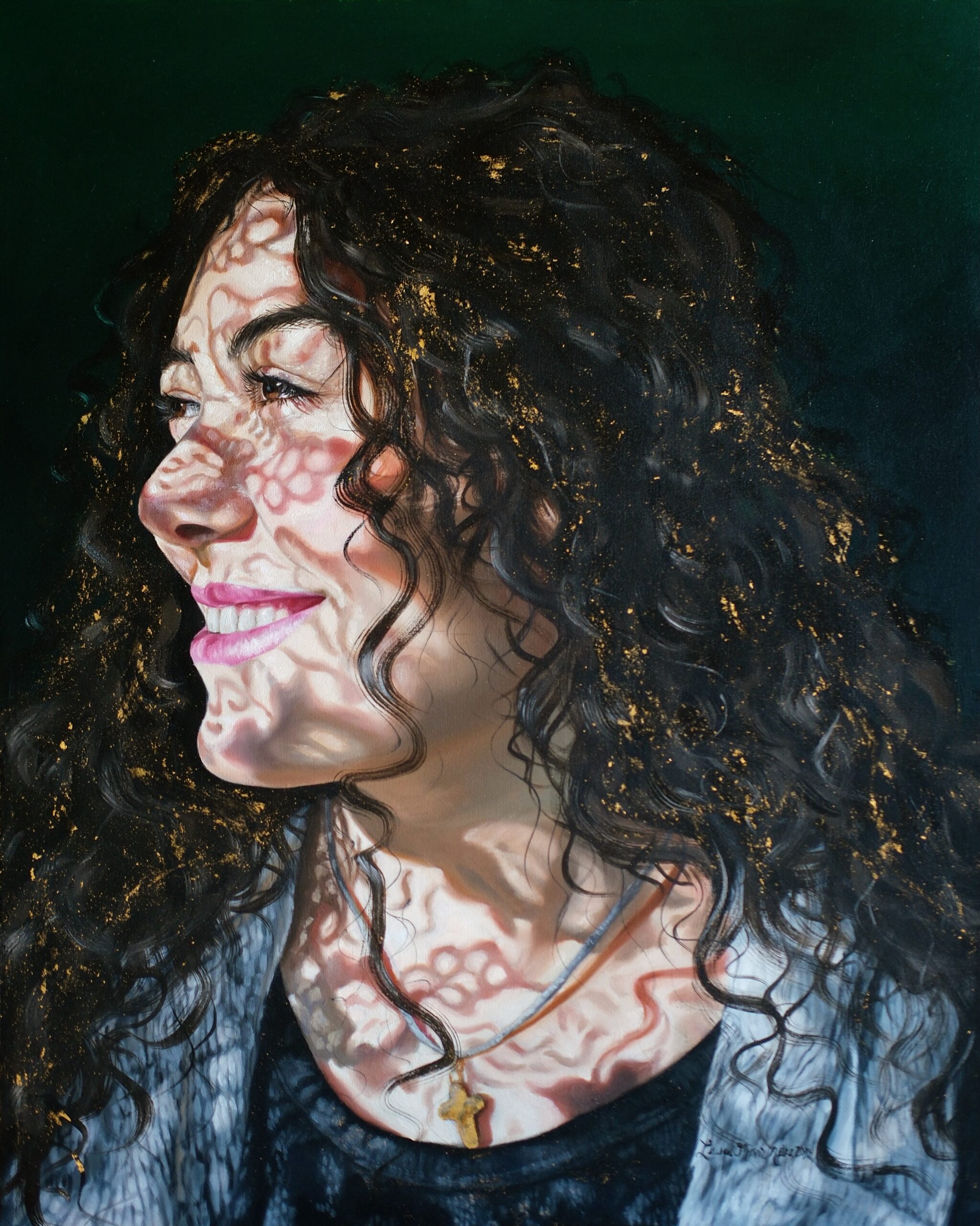
Aseel, 2024, oil on wood, 18 by 24 inches. Artwork and photo: Lauren Marie Nitka.
By Daniel Johanson
In Heirs & Heiresses, a recorded faith testimony guides the photograph she chooses to paint.
“I first recorded Aseel's testimony,” Lauren Marie Nitka wrote in an email interview.
For the Milwaukee artist, the recording precedes the image. In Heirs & Heiresses, she documents Christians’ accounts of their faith through recorded testimony and painted portraits.
“Once I heard the peace she was describing, that gave me a direction for the photos I then took of her,” Nitka wrote.
Aseel's finished portrait carries a pattern of lace shadows across her face, with gold leaf scattered around her dark hair. Nitka describes the light and shadow as an expression of God's presence in the portrait.
“Each portrait in this series features cast shadows of intricate lace,” she wrote.
She photographed Aseel under a tent of lace and worked through many photographs before choosing the image to paint.
“After taking many photos, I then selected the one photo in which Aseel's face showed the most peace, as she gazed towards the light,” Nitka wrote.
Choosing that frame gives the painter editorial control, even while the recording aims to leave room for the sitter's account.
“During the process of recording and photographing, the person gets a lot of say in how they represent themselves or pose, but I'll have the final editing selection of which photo gets painted that matches their overall story based on emotion,” she wrote.
The testimony has a different kind of editing. Nitka describes keeping the recording close to the account the person wants to give.
“For the recorded testimonies, I leave their story as unedited as possible,” she wrote.
“The only edits I'll make is if someone asks for a break or to restate their thought.”
That aim also leaves room for differences among the people she records. Nitka has interviewed Christians of varying denominations and wants to retain their beliefs without making them uniform.
“I want to preserve their beliefs authentically,” she wrote.
She also places Aseel's portrait in conversation with the Christian art she knows. It is painted on wood with gold leaf, materials she associates with Eastern iconography.
“I wanted to pay homage to the Christian art tradition that has faithfully depicted followers of Christ,” Nitka wrote.
The painted expression comes from a longer account the viewer can encounter in the recorded testimony. Nitka chooses one photograph to carry that story into paint while keeping the sitter's own words alongside it.
