
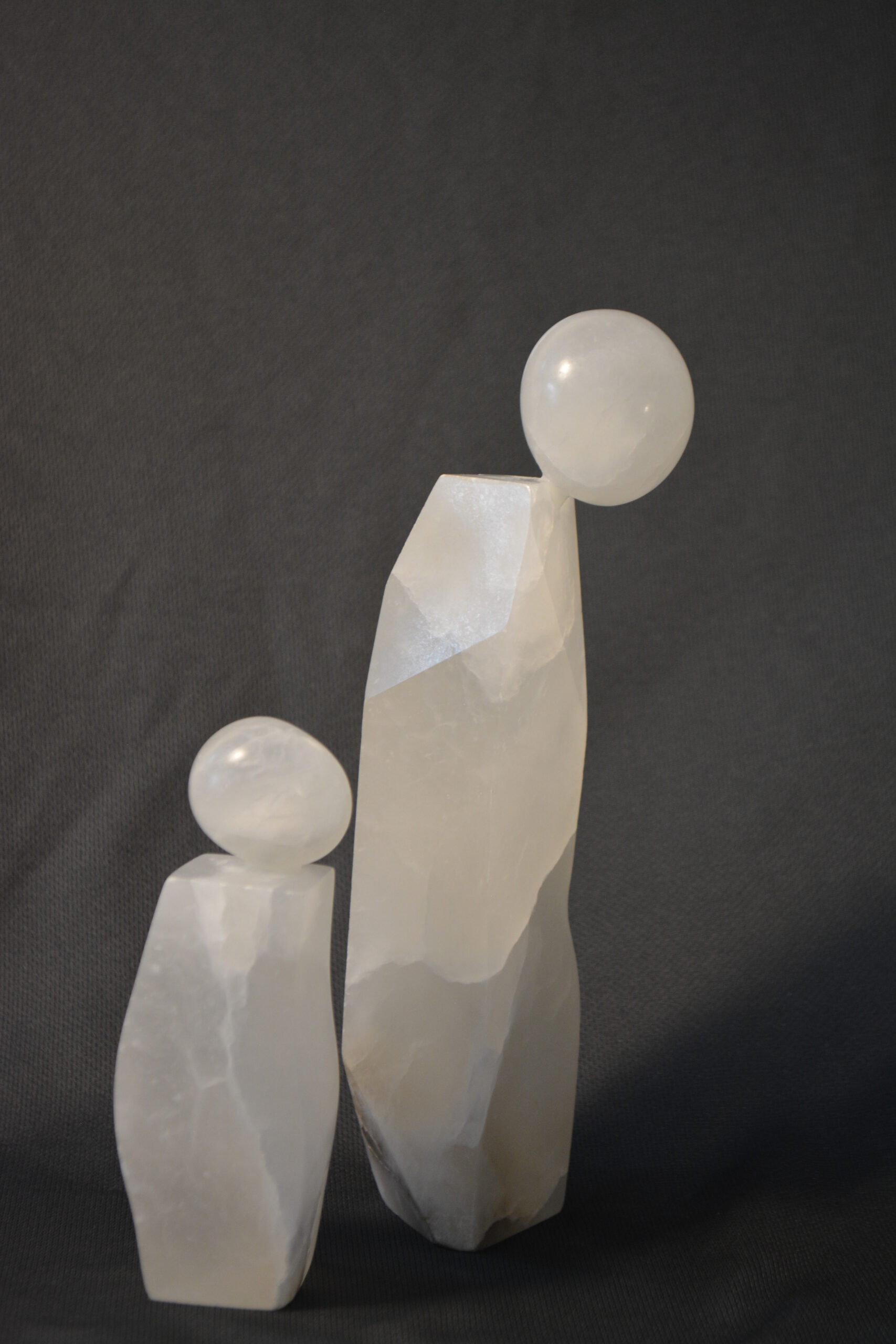
Father and Child, alabaster sculpture. Photo: courtesy Tomas Co.
By Daniel Johanson
A digital print and an alabaster sculpture give Father and Child different relationships, each worth keeping on its own.
“The darker parts of the alabaster were used to express a rough journey of the father,” Tomas Co wrote in an email interview.
The stone gave Co a different way into Father and Child, an idea he had first made as a digital print. In that earlier image, he wanted a steady, confident father guiding a child full of wonder. Carving the figures in alabaster a few years later changed their relationship.
“The medium and material allowed me to change the narrative,” Co wrote.
He used the darker areas of the stone for the father’s difficult journey, and a head leaning forward to suggest exhaustion. The figures were now physically separate, allowing the child to be positioned looking up toward the father for guidance and support.
Those changes let the sculpture stand as its own work. Co describes an affinity for minimalist abstract art and a wabi-sabi aesthetic, but following the material can take the same subject somewhere the earlier version did not.
“When I make 2D and 3D versions of the same idea or theme, I treat both versions to be separate and independent,” Co wrote.
Moving between media also changed how he approached the posture of jazz pianist Bill Evans. In the watercolor Peace Piece, masking techniques let him bring light into contrast with dark surroundings, illuminating the face to express a meditative mood.
Co tried different sculptural materials to carry that image into three dimensions. He described those results as disappointing before finding a way forward with paperboard.
“I was able to obtain a minimalist capture of the iconic posture with the accompanying mood,” Co wrote.
The resulting Bill Evans is a separate answer to the posture that interested him in the painting. It is one example of the movement between sculpture and images in Co’s art practice.
Keeping versions gives him something to return to. With paintings, he tries to avoid enhancements or corrections, holding on to several versions so he can explore their differences later. With sculpture, he makes maquettes that he can revisit.
“In either case, my decisions to stop or continue are based strongly on my own emotional and psychological reactions to the piece,” Co wrote.
He calls that process a generative Rorschach test, using the work to explore his changing sense of himself. The decision to keep a version can preserve something that further manipulation might erase.
“I want the art output and versions to help me explore who I am and who I am becoming,” Co wrote.
For Father and Child, keeping both versions leaves the confident guide and the exhausted father available as different encounters with the same idea. The material gave Co another relationship to consider without requiring him to discard the first.
