
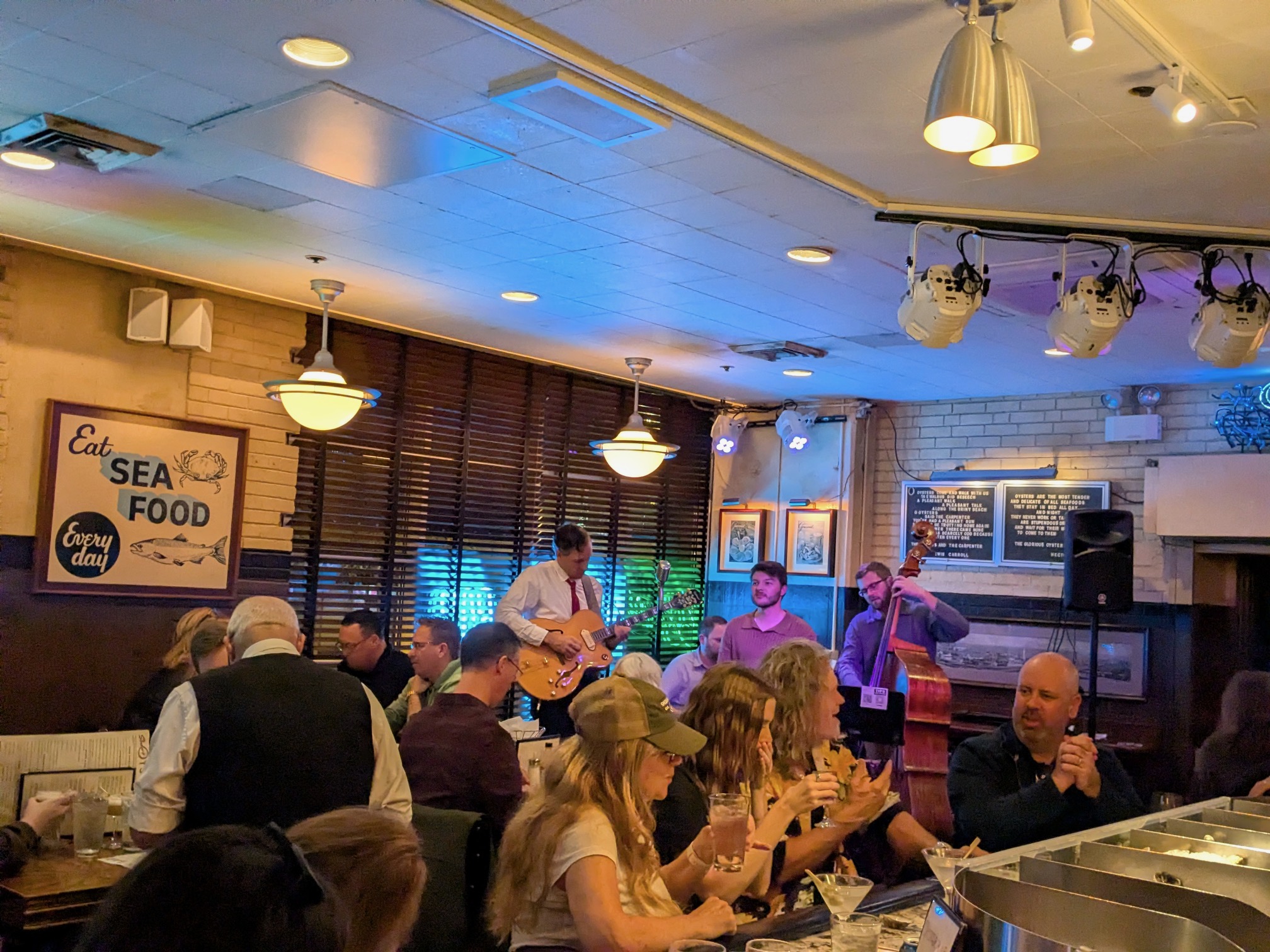
From left: Allan Laskey on guitar, Brendan Smyth on drums at the rear, Grant Nicholaus on trumpet and Denis Kozlowski on upright bass at Shaw’s Crab House in Chicago, Oct. 29, 2026. Photo: David Elliott.
During a recent gig, Allan Laskey began repeating the rhythm of a trumpet player’s last two notes in his own comping. The trumpeter picked up on it and left more room, Laskey recalled.
“There’s a certain amount of chaos expected and it’s how we navigate things going sideways that can make or break a performance,” Laskey wrote in an email interview.
The exchange grew from listening to what another player was doing. Laskey describes that responsiveness as a reason he was drawn to jazz.
“My main concern is playing what I want when I want to,” he wrote.
Returning to a familiar tune gives him something he already wants to play with. He chooses much of the repertoire because a melody or a chord movement appeals to him.
“Most of the tunes we play, I picked because I like the melody or the chord movement,” Laskey wrote.
“I want to sound good over forcing innovation,” he wrote.
His preparation works on the technical choices he can reach for during a performance. Metronome practice, scales and chord-inversion drills are part of that work.
“This is so I have the tools in my bag when I want them,” Laskey wrote.
He also studies Charlie Parker tunes and Kenny Burrell solos. That study supplies language he can use while listening to the band.
“Most of my soloing language comes from those two masters,” he wrote.
The technical work gives him choices, and the other musicians give those choices somewhere to go. At the gig he described, a rhythm heard in a trumpet solo became something he could answer.
“Jazz is a group activity and the whole is greater than the sum of its parts,” Laskey wrote.

Be First to Comment