
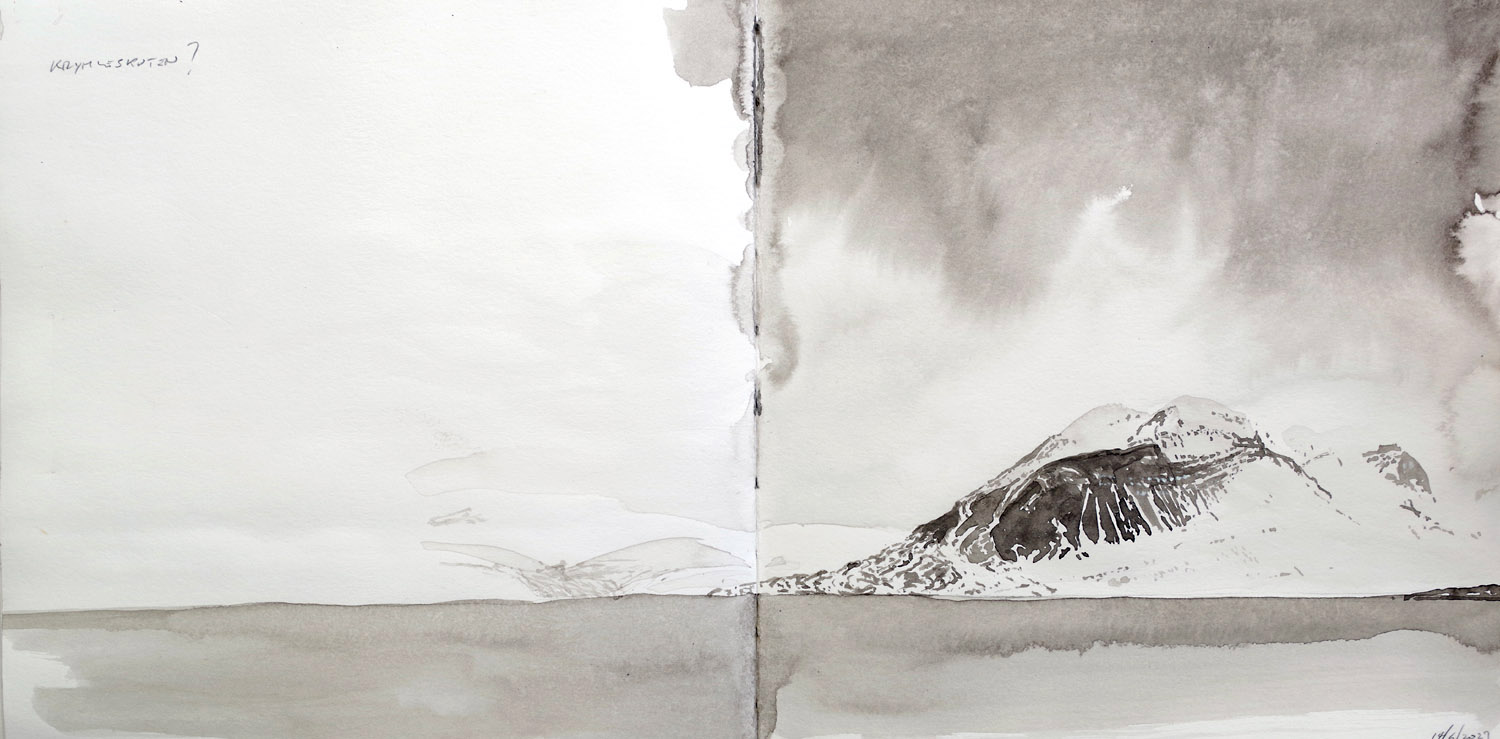
Krymleskuten, field sketch, 2023. Artwork: Ian Brooks. Photo: Ian Brooks.
“I made half a dozen sketches over an hour or two on the bridge, trying to capture the rapidly changing views as the ship sailed by, racing the fast-changing light as low clouds moved across the mountainsides,” Ian Brooks said in an email interview.
Brooks places the sketch in early summer 2023, when the Swedish icebreaker Oden was returning to Longyearbyen after he had spent six weeks aboard. While the ship waited for a pilot, he drew Krymleskuten, a mountain on Svalbard’s coast beside Isfjorden.
“While the nominal subject is the mountain, the shroud of low cloud and the changes in contrast between clouds and mountains provide the atmosphere and the real subject,” he said.
His field sketch took about 15 minutes, Brooks said, and used only washes of acrylic ink. Turning that brief study into the etching Krymleskuten meant deciding which marks needed to stay precise and where variation could remain.
“Back in the studio I made a smaller study, based on the initial sketch, in the format I planned for the etching. This is primarily to check the planned composition and tonal contrasts, and acts as a guide when making the etching,” Brooks said.
“The etchings are built from many layers of tone, each drawn as either positive (areas to etch) or negative (areas to mask out and prevent etching), then etched ‘spit bite’ – the acid applied to the plate with a soft brush,” he said.
“I start by drawing whatever part of the image best acts as an anchor for the rest of it, establishing the scale and position on the plate. Here that was the exposed rocks.”
The rock patterns were also a place to interrupt that precision. “It can be hard to draw the random patterns of interlaced rock and snow, so I ‘rough up’ the drawing a bit, applying random marks with a fine sponge,” Brooks said.
“The clouds, and the softer tones in the snow, are achieved by loosely painting acid onto the plate without previously drawing or masking the area to be bitten. Random variations in tone occur where the acid beads up on the plate because of surface tension,” he said.
“In the foreground snow, the beads are allowed to sit for a while, giving well-defined, but soft details. In the clouds, the acid is kept moving with the brush to prevent well-defined edges forming, giving an appearance similar to watercolor washes on wet paper.”
The printed image brings those separate layers together. “While the image is built up of many separate layers, when printed they cannot be distinguished from each other, and the whole image acquires a uniform finish, while ranging from the subtlest of tones to deep, velvety blacks,” Brooks said.
For Brooks, allowing chance elements also counters a habit that can make a drawing feel overworked. “My natural tendency is toward careful drawing and, probably excessive, detail. This can kill the artwork, leaving it feeling fussy and lifeless, and is something I consciously fight,” he said.
“Then I have to respond to those random marks, allowing the image to dictate what is needed to finish it, rather than trying to reproduce the reference too carefully. When it works well, I can get images that surprise and delight me, things I wouldn’t, or couldn’t, necessarily have planned,” Brooks said.
“And when it doesn’t work…well, I can always start over on a new plate.”

Be First to Comment