
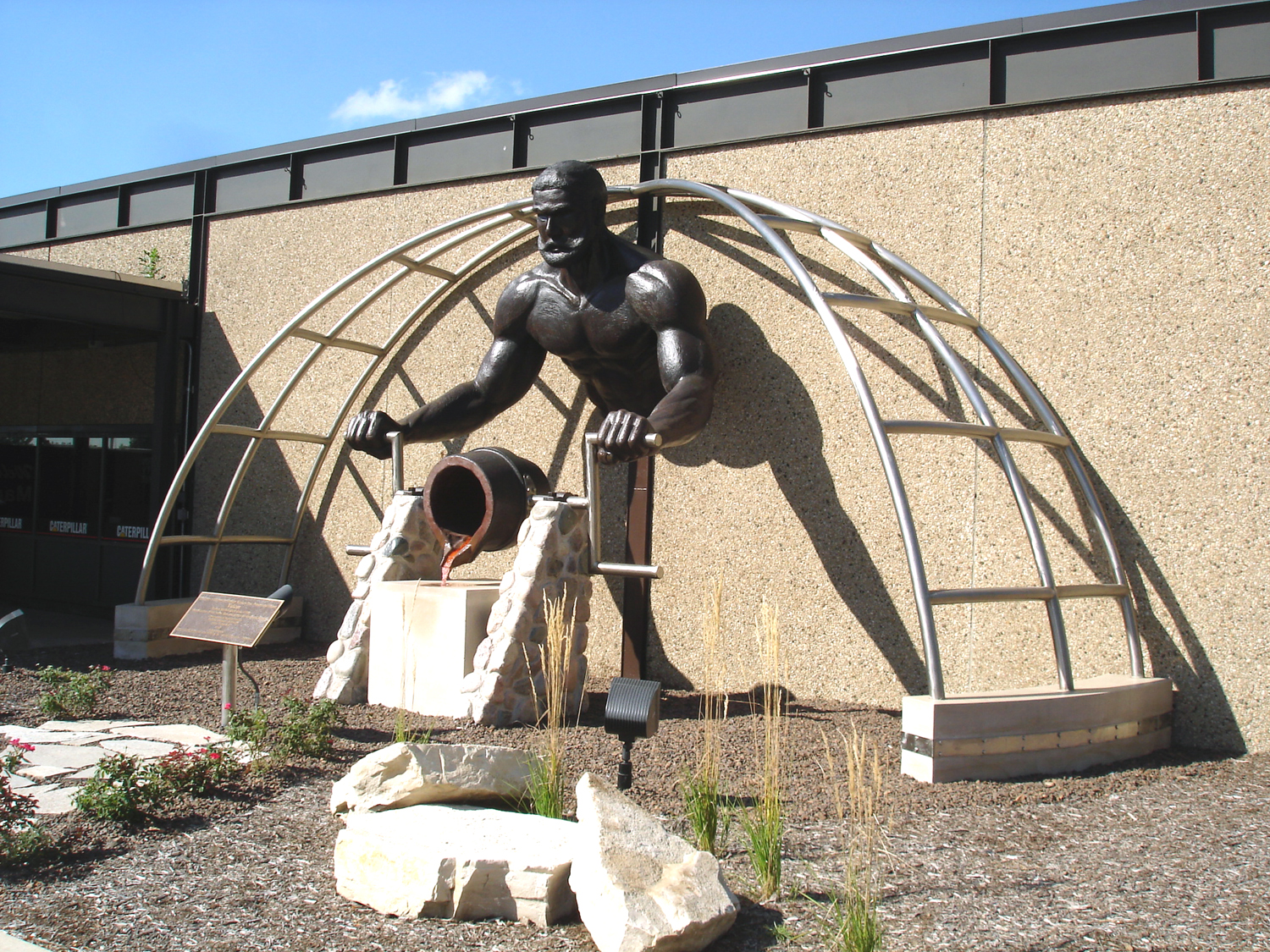
Vulcan at Caterpillar’s Mapleton, Illinois, foundry. Photograph by Fisher Stolz.
Orange-lit water pours from a crucible into a mold in Fisher Stolz’s account of Vulcan, his commission for Caterpillar’s Mapleton Foundry. The action refers to the work taking place inside the building where the sculpture is displayed.
“The sculpture runs orange-lit water from the crucible into a mold to simulate pouring molten iron,” Stolz wrote in an email interview.
Stolz described a figure three times life-size, totaling 7,000 pounds of iron, which he said had to be poured at Mapleton. Casting the figure there connected its making to the foundry workers whose joined capacity he wanted it to represent.
“Here, the clients gave me representational input, and I used representational and abstract methods to relate the idea to the site.”
The figure emerges from arcs depicting latitude and longitude, which Stolz relates to Caterpillar’s global business. Curved limestone and arced tubing connect the commission to forms used elsewhere in his work.
Each material also has a job in the setting. “I needed the stainless steel, limestone, and fieldstone to be durable materials, and the iron to relate to the foundries housed inside,” he wrote.
The installation becomes familiar through repeated encounters. “The people who work at the facility know it well; it has become part of the location's fabric.”
For Stolz, working at a public scale also involves deciding how much room a sculpture takes in someone’s day.
“My public artwork is larger than a person, but not so dominating,” he wrote. “Ideally, a sculpture can be seen from a distance and interacted with up close.”
He describes works that invite people to move around them and, in some cases, into spaces within them. Planning also means accommodating disabled people who encounter a site.
“Seeing people interacting with previous public works influences concepts for new ones,” Stolz wrote.
Returning to an installed work brings another set of material decisions into view. “I have found that road salt is rough on stainless steel, so avoid locations where that is a problem.”
That observation can shape where the next sculpture goes. Changing light and seasons also alter how a work is perceived, Stolz wrote; the site keeps presenting conditions the studio cannot settle in advance.
The responses Stolz remembers also include how people chose to occupy a space within the work. He recalled one response to New Era: “A couple was married underneath New Era when it was at the Navy Pier in 2000.”
“That was a nice response.”
