
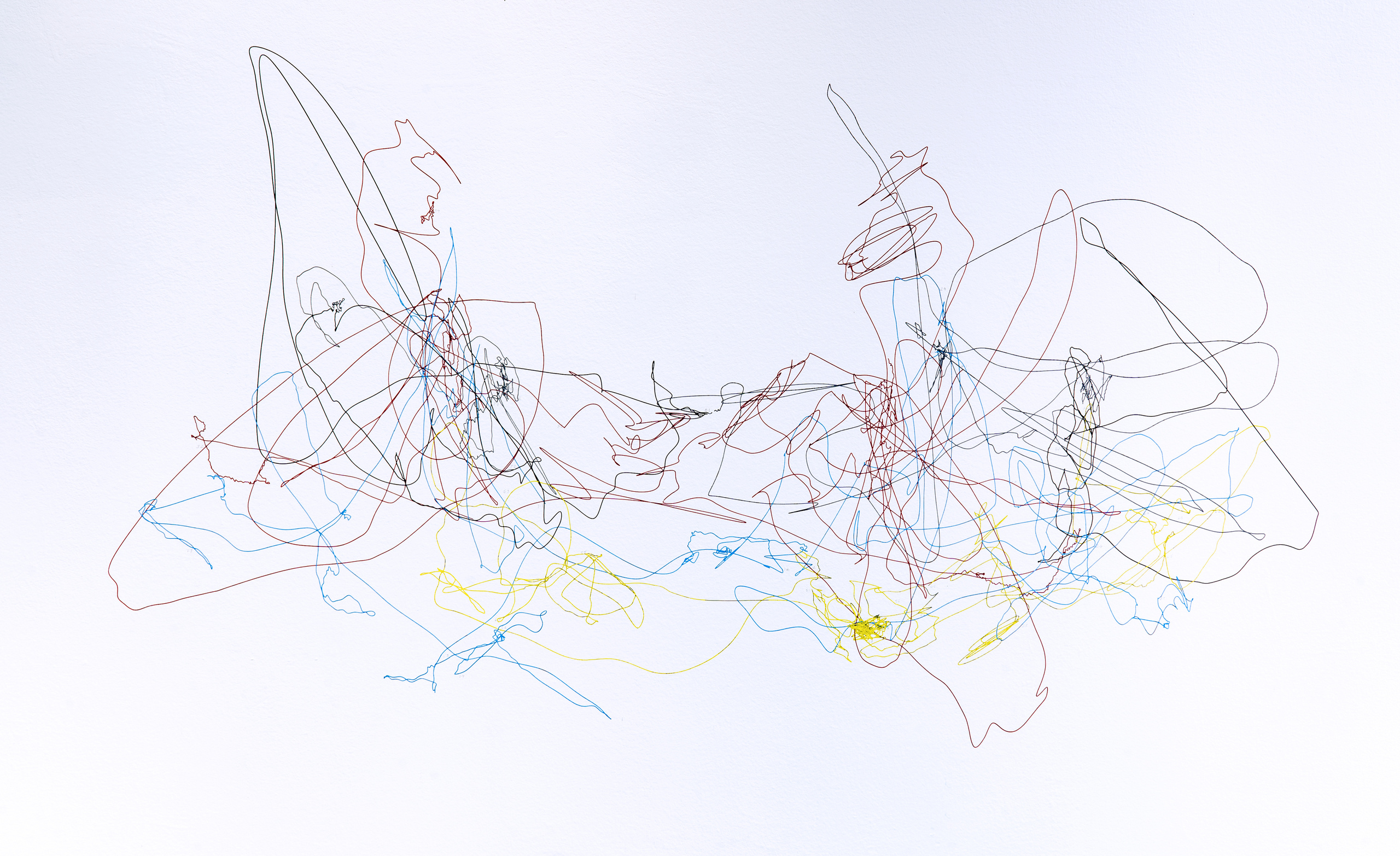
Found Gestures drawing by Susan Giles and Sally Morfill, recording Molly Dunson, Ethan Larbi, Ashley Lazaro and Emanuel Wiley speaking about Folayemi Wilson’s Dark Matter: Celestial Objects as Messengers of Love in These Troubled Times at Hyde Park Art Center. Photo: Tran Tran.
Each teenager chose a color. When Susan Giles and Sally Morfill overlaid recordings of their hand movements into a single drawing, those colors helped distinguish the people describing the same installation.
“We were struck by how differently each teen perceived and experienced the same installation,” Giles wrote in an email interview.
During their residency at Chicago’s Hyde Park Art Center, the artists invited teens to describe an exhibition by Folayemi Wilson while motion-capture technology recorded their gestures. The resulting drawing was paired with a plaque containing the speakers’ colors and transcribed words.
“The individual recordings became a kind of collective conversation when we overlaid their gestural movements into a single drawing,” Giles wrote.
Found Gestures is a fully collaborative project by Giles, a Chicago-based artist, and Morfill, an artist based in Manchester, England. Their conversations with participants begin with an open-ended question, leaving room for different accounts of what someone has seen.
The drawings give those accounts another way to be read. On Giles’ project page, she describes wall drawings made from numbered vinyl line segments, with a transcript beside each drawing that connects speech to the movement recorded during it.
“We tend to select gestures that reveal something beyond what words alone convey, or that create a visual metaphor,” Giles wrote.
For the project’s London exhibition, a participant described an exhibition as “constantly changing.” His gesture became both a drawing and a 3D-printed form, which Giles describes as a spinning ball of circular lines.
“It conveys both speed and a sense of containment, giving physical form to something the words alone don’t fully express,” she wrote.
Those forms returned to the places the participants had been describing. In Chicago and London, Giles and Morfill spoke with people connected to community-based art spaces, then exhibited the drawings and 3D prints in the galleries where the remembered artworks had been shown.
“There was a kind of looping effect to this work,” Giles wrote. “This became an extension of the life of the original exhibitions.”
“We came to understand the project as a kind of alternative archive, preserving personal experiences and perspectives that conventional exhibition documentation might overlook,” Giles wrote.

Be First to Comment