
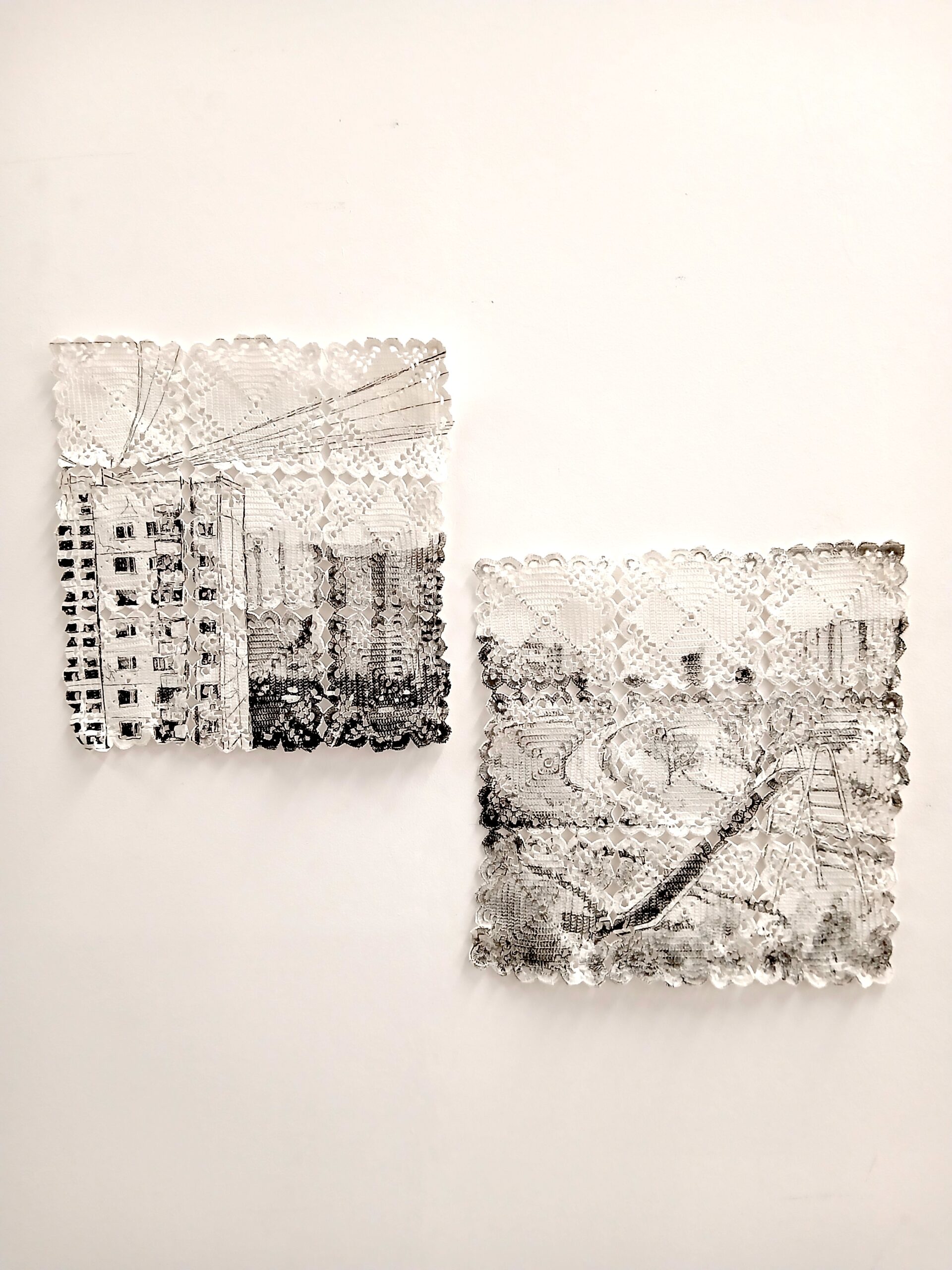
Rusting Memories by Usva Inei, zinc etchings printed on crocheted doilies. Photo: Usva Inei.
Decorative loops interrupt the buildings in Usva Inei‘s “Rusting Memories.” Two zinc etchings printed onto crocheted doilies bring an urban landscape into objects associated with the home, and leave parts of that landscape missing.
“Because of the tight weave, the etching printed well onto the crochet, but its decorative loops create holes in the image,” Inei wrote in an email interview.
The work began with memories of a Moscow suburb where Inei partly grew up, alongside anger toward the Russian government and its war. Inei describes the piece from a queer, antiwar migrant perspective, with affection for remembered places remaining entangled with exclusion and repression.
“Now, I am unable to go there due to my antiwar political views and my identity as a queer person,” Inei wrote. “Therefore any processing of my heritage can only be done remotely.”
Memories and photographs taken in the early 2000s became drawings and collages, then zinc etching plates. Soviet architecture, playgrounds and neglected landscaping supplied the imagery.
Etching offered a drawing-like delicacy, while making the plates brought another physical quality into the work. Inei used hard ground and aquatint to create the images.
“Manipulating the metal as a process is very physical and almost aggressive, and hence felt like an excellent tool for expressing complex feelings, nevertheless resulting in quite delicate imagery that shows the intricacy of emotion,” Inei wrote.
Printing the same image onto different surfaces created room to keep testing the relationship. Inei wanted a domestic textile with a connection to Eastern European traditions, potentially something handmade, to sit alongside the mass-produced buildings and playgrounds.
“Textiles, on the other hand, allow for a connection with tradition, craft, and heritage,” Inei wrote.
The crochet supplied that connection while changing what the image could show. The gaps became part of the work’s account of remembering.
“The fabrics used to create the piece provide a cultural link to Slavic roots, but also create a veil for the image: we can remember, but we can never fully get back to this place,” Inei wrote.
Inei wants viewers to have the personal and political context, without requiring everyone to read the work in the same way. The doilies might suggest objects placed in a home, or a curtain through which someone looks outside.
“The pieces of the images that are missing can be filled in with viewers’ personal experiences and emotions, creating new scenes among the interaction with the art piece,” Inei wrote.

Be First to Comment