
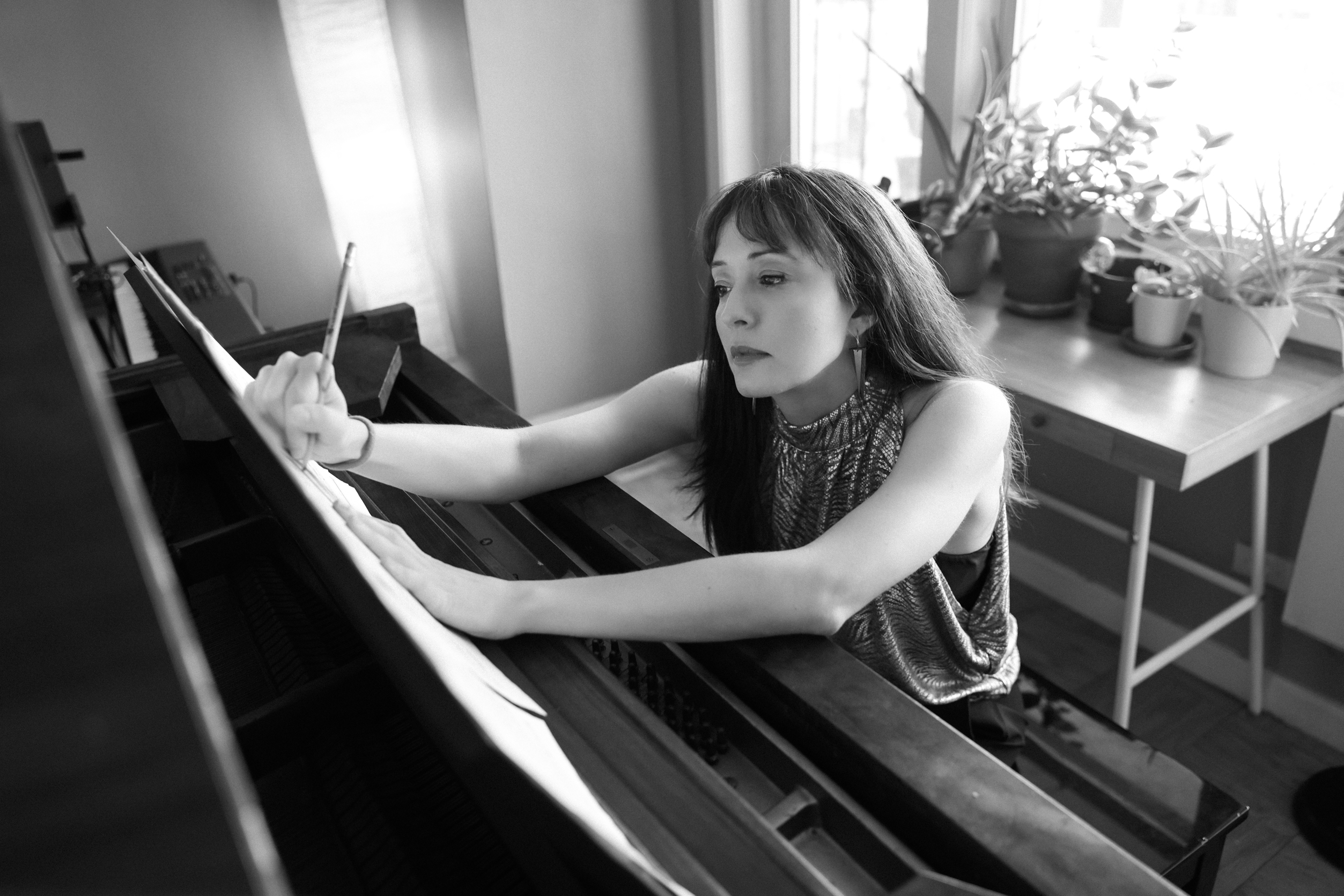
Photo: Ogata.
For “One for Blake,” Marta Sánchez wanted a constant rhythm and a rock feeling. The Blu-Tack, rubber and tape she brought to the piano followed that intention.
“Normally, the sounds don’t lead me toward compositional decisions; rather, the compositional decisions lead me to the sounds,” Sánchez wrote in an email interview.
The piece appears on For the Space You Left, her first solo album, written for prepared piano. To get the percussive sound she wanted for “One for Blake,” she prepared a couple of strings with Blu-Tack and rubber.
“Then I taped the lower strings to get a more aggressive bass line,” she explained.
Writing for piano alone puts the different parts into one player’s hands. “The concept is similar, but it changes the timbre, the colors, and the possibilities,” Sánchez wrote, comparing the work with writing for her quintet.
“I have to be able to play all the layers at the same time. The sounds I have at my disposal also influence the melodies and harmonies.”
That also changes which melodies she imagines. “The melodies I imagine for saxophones, for example, are not the same as the melodies I imagine for piano.”
In performance, Sánchez keeps the written material intact and improvises with material from the tune. An introduction may open one piece; in another, a bass or middle line stays in place while she improvises over it.
“Actually, the improvised sections are different in every piece,” she wrote.
The preparation begins with a compositional decision, and the improvisation retains a connection to what she has written, even when its form is open. “In others, I just improvise more openly, using the material and the essence of the composition,” Sánchez wrote.

Be First to Comment