
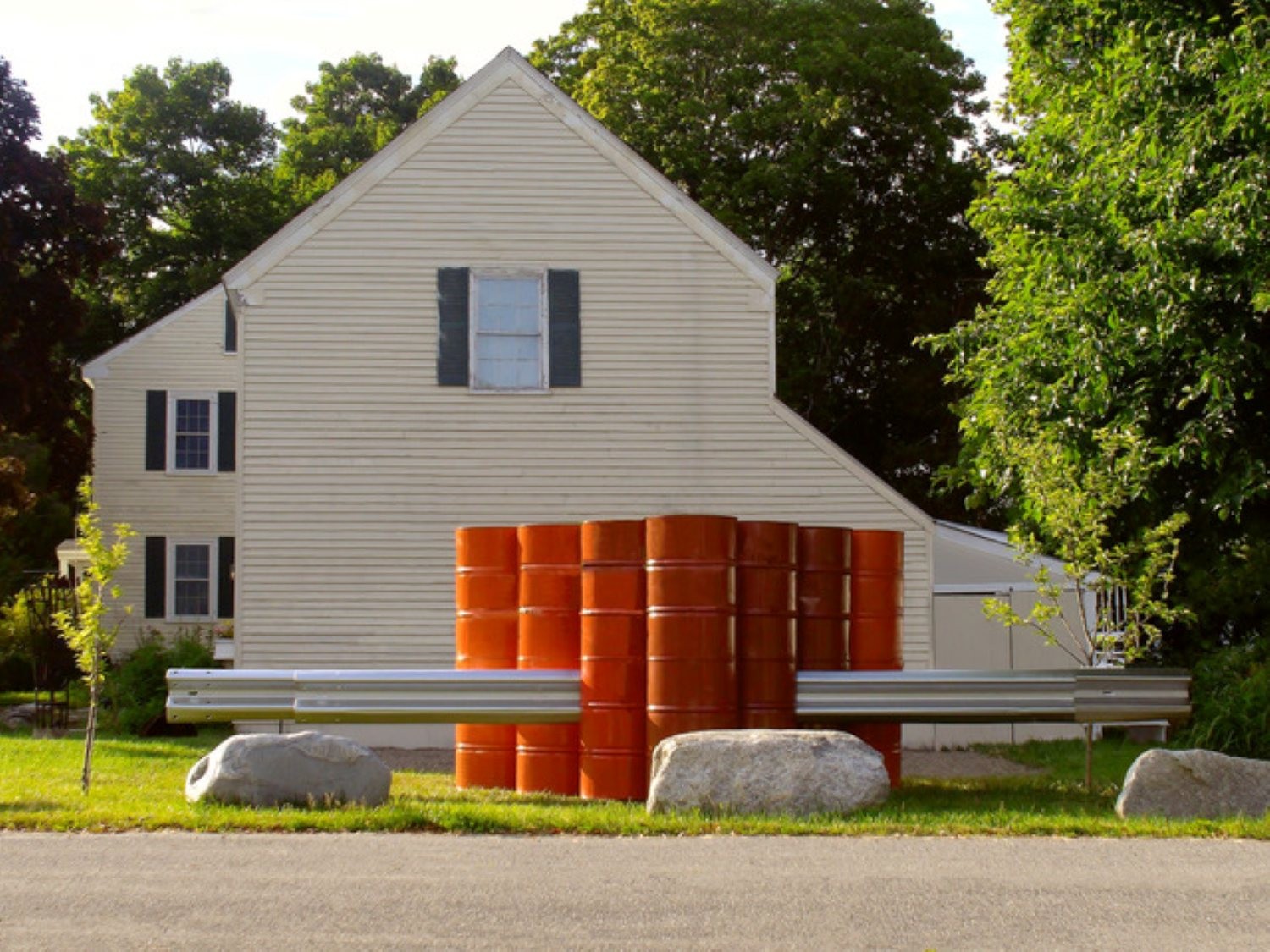
STATIONS 5 at Parsonage Sculpture Garden, frontal view. Photograph: Roland Biermann and Parsonage Gallery.
“The oil barrels show numerous dents and scratches and one of the crash barriers in Stations 5 is actually crash-impacted,” Roland Biermann wrote in an email interview.
The materials in STATIONS 5 arrive with evidence of having been used. In the sculpture at Parsonage Sculpture Garden in Searsport, Maine, barrels and motorway crash barriers carry that history into a different arrangement beside Penobscot Bay.
“The signs of use add a very special story to what otherwise might be very uniform industrial materials,” Biermann wrote.
The sculpture continues his STATIONS series, which he described as both a reinterpretation of the Stations of the Cross and an inquiry into blood spilled in the pursuit of fossil fuels. Its barrels range from bright red to darker, brownish reds.
“The oil barrels are painted in different shades of red, ranging from a bright red to very dark, brownish shades of red, similar to the change in colour that goes along with fresh blood that congeals and dries,” he wrote.
Biermann connects the bright red barrels at the ends with resurrection and the life cycle. The crash barriers bring another kind of history into that reading.
“The crash barriers are removed from their stands along the roadside,” he wrote. “In a sense, they are out of control.”
He describes the beams slicing and piercing the barrels, suggesting violence through materials associated with the automotive world. Their dents remain visible, including the deformation left in a barrier that had actually been hit.
At Parsonage, the placement of those materials also responds to the surrounding landscape. Biermann contrasted the installation with earlier, more vertical works in the series that echoed high-rise buildings.
“For the Parsonage Sculpture Garden in Searsport, Maine, looking out across Penobscot Bay, I felt a much more low-rise, horizontal structure would be most appropriate,” he wrote.
Fourteen barrels form seven columns, with two barrels stacked in each. The columns stand on a steel platform in a V-shaped arrangement, its point facing the ocean.
“The pointy end of the V faces the ocean and may remind the audience of the bow of a ship going out to sea,” Biermann wrote.
The open end faces the garden and gallery building. He sees the possibility of an enclosure or protection in that side of the shape, while two parallel crash-barrier beams cross the barrels.
“The crash barriers run parallel to the ground, similar to the way they can be found on the roadside,” he wrote. “Only here, they are removed from their stands and seem to be floating above the ground.”
The objects remain recognizable- barrels still look like barrels and roadside barriers retain their long, horizontal form. Their new positions let the same material suggest a ship or an enclosure, while the barriers slicing and piercing the barrels suggest an act of violence.
The coastal site keeps changing what those surfaces do. Biermann described different reds and silvery reflections appearing with the time of day and season.
“The handbrushed barrels may remind the audience of a light house as the coastal fog rolls in and they cast a rich, warm glow in the evening sun, whilst the highly reflective crash barriers jump out from the dark, when caught by the headlights of a passing by car at night.”
Sound also enters the work through its setting. Vehicles driving past the sculpture garden and airplanes in the sky become part of Biermann’s account of an installation made from materials tied to fossil fuels. The steel contributes a sound of its own.
“As the sun beams on the barrels, they heat up, the metal body expands and eventually produces a dark, metallic bonging sound,” he wrote. “The same happens in the evening when the temperatures drop and the metal contracts.”
He described people returning to sit in front of the sculpture and wait for that change. Materials that still carry the marks of an earlier impact have become something a visitor might stay to hear.

Be First to Comment