
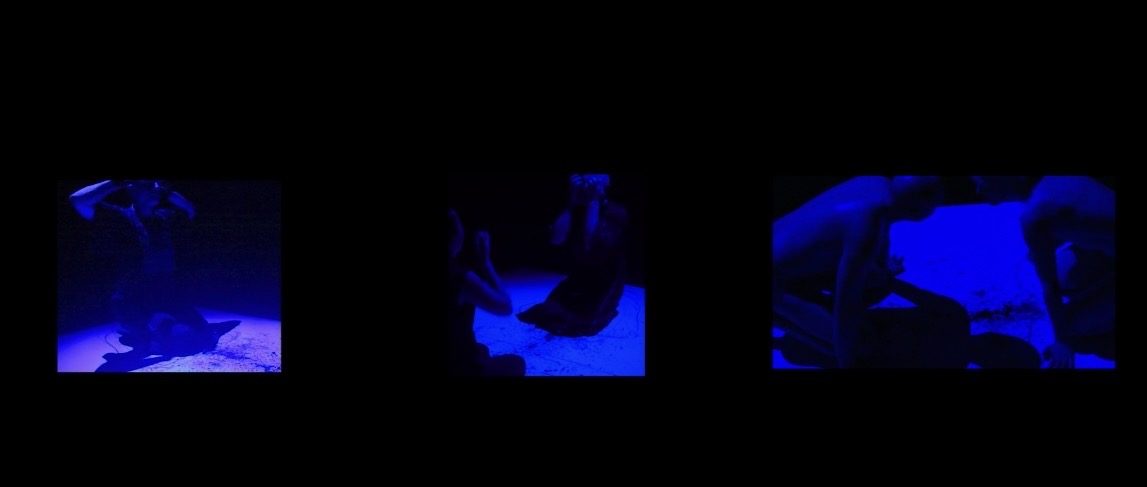
Hidden movement and repeated marks in the earlier SPLIT Lamentations echo within Seth Sexton’s ongoing Blueprint for Queer Lamentations.
Three-panel video still from Blueprint for Queer Lamentations. Pictured: Seth Sexton, Lila Ghasempour and Maria Plotnikova. Cinematography: Seth Sexton.
In Seth Sexton’s account of SPLIT Lamentations, a piece of charcoal turns inside the mouth before it leaves a mark on paper. The drawing begins with a movement the viewer cannot directly see.
“Its existence becomes visible only when the performer ejects the charcoal onto the paper. As the action repeats, changes in pressure, saliva, breath, aim, weight, reach, and pause alter the marks,” Sexton said.
Sexton created SPLIT Lamentations before Blueprint for Queer Lamentations, his ongoing larger project. He describes the earlier piece as an echo within that larger body of work. Across the two, repetition offers a way to give grief structure while allowing each return to change it.
“Dance has taught me to understand repetition as a phrase rather than a copy. Every repeated action contains a different pressure, duration, rhythm, and relation to what came before,” he said.
That distinction gives the hidden tongue movement a place in the drawing’s choreography. “Each ejection transfers the accumulated energy of an internal movement into a visible mark,” Sexton said.
Sexton also describes an erotic charge in the spit: a pull toward contact that exists alongside disgust. He distinguishes that charge from a claim that the work is sexual. In SPLIT, saliva carries charcoal from inside the mouth onto a shared surface, leaving what he calls “an intimate trace that also risks recoil.” That tension between approach and refusal extends his account of queer grief without making it fully exposed or contained.
The visible pattern carries those variations, which complicate the promise of a blueprint. “A blueprint suggests a stable plan, while lamentation is bodily, temporal, and resistant to containment,” he said.
In the larger project, he describes repetition as returning to grief without reproducing the same experience. The body changes with the return, and so does the pattern.
The movement continues when a drawing enters an installation and a viewer approaches it. “Up close, the viewer encounters charcoal, spit, abrasion, texture, and individual impacts. From farther away, those incidents gather into fields and patterns,” Sexton said.
Those changes of distance make looking a physical activity in his account: eyes travel, heads turn and weight shifts. Yet closer attention doesn’t make all the work’s making available.
“The viewer encounters evidence of an action while much of the labor that produced it remains inaccessible,” he said.
For Seth Sexton, that partial visibility is central to Blueprint for Queer Lamentations. The mark offers evidence of a body and its movement; it leaves room for what a viewer cannot recover.
“Queer grief is often encountered through fragments, traces, repetitions, and absences,” he said. The drawing gives those traces a structure someone can move around, without making the grief they carry stand still.

Be First to Comment