
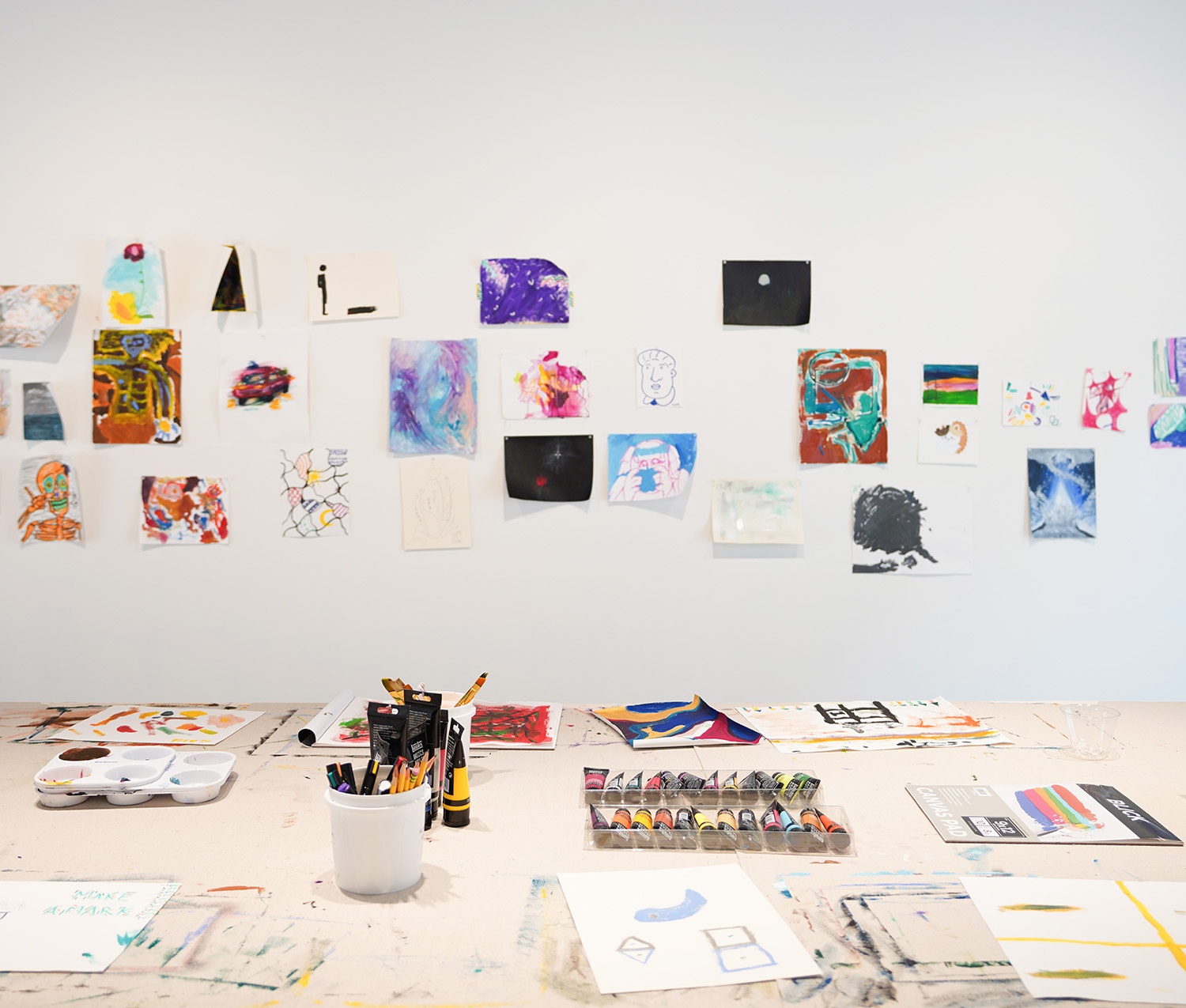
Installation view of exhibition Painters’ Painters, August 2026. Image courtesy SECRIST | BEACH.
For Painters’ Painters, SECRIST | BEACH put two long tables in its salon and supplied acrylic paint, brushes, canvas paper and tacks. The room between the gallery’s exhibition spaces became somewhere visitors could make a painting and leave it on the wall.
“At the end of the show we had over a hundred paintings tacked up on the walls of the salon,” SECRIST | BEACH director Britton Bertran wrote in an email interview.
“There was something incredibly visceral about making artwork in a gallery space and leaving it behind – joining the exhibition in a very real way,” Bertran wrote.
That use of the room grew from an exhibition about commitment to painting and relationships between painters. Bertran reported that visitors spent more time making their own paintings than viewing the exhibition.
The salon’s location gives those activities a specific job. It sits physically between two exhibition spaces, linking a solo presentation with a group show that draws on its ideas and visual strategies.
“It performs like a bridge between ideas,” Bertran wrote.
“The salon is a mental pause between the two which allows visitors to experience a third mode of viewing – specifically designed to slow down, or pause the act of looking,” Bertran wrote.
A site-specific installation by Chicago-based duo Luftwerk made that pause a matter of watching colors transform. In Landscape is a Composition (Light to Dark) and Landscape is a Composition (Dark to Light), opposite walls of the salon were painted with concentric rectangles of Naples yellow to Prussian blue, and inverted blue to yellow on the other.
“These walls were then projected on with lights that slowly cycled through the spectrum of visible color, re-inverting the process all over,” the gallery said in a subsequent email.
Luftwerk’s salon installation conceptually and physically linked Anne Lindberg’s solo exhibition and its attention to blue with the concurrent survey exhibition Manifest, which brought together work exploring color, light and space. The salon offered a way to spend time within those concerns before returning to the surrounding work.
A commercial gallery also makes visitors aware that work is available to clients. Bertran described the salon’s videos, sound performances and makeshift libraries as ways to make the space more inviting within that setting.
“The installations in the salon are meant to be taken in unencumbered by the traditional gallery-going experience,” Bertran wrote.
With Painters’ Painters, that meant giving visitors materials and a place to work. The paintings they left behind made the salon’s connection to the exhibition tangible- their contributions became part of what later visitors could see.

Be First to Comment