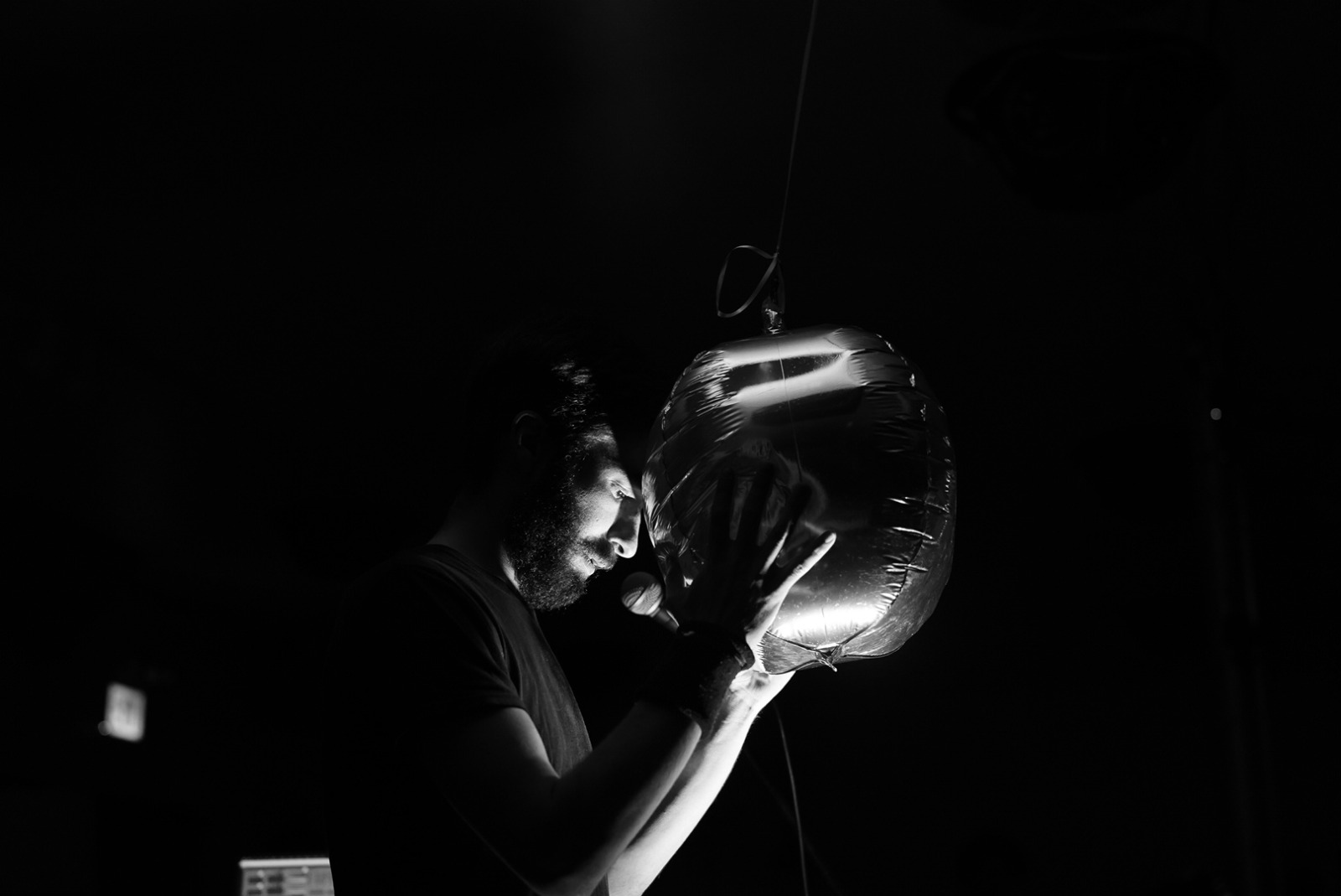
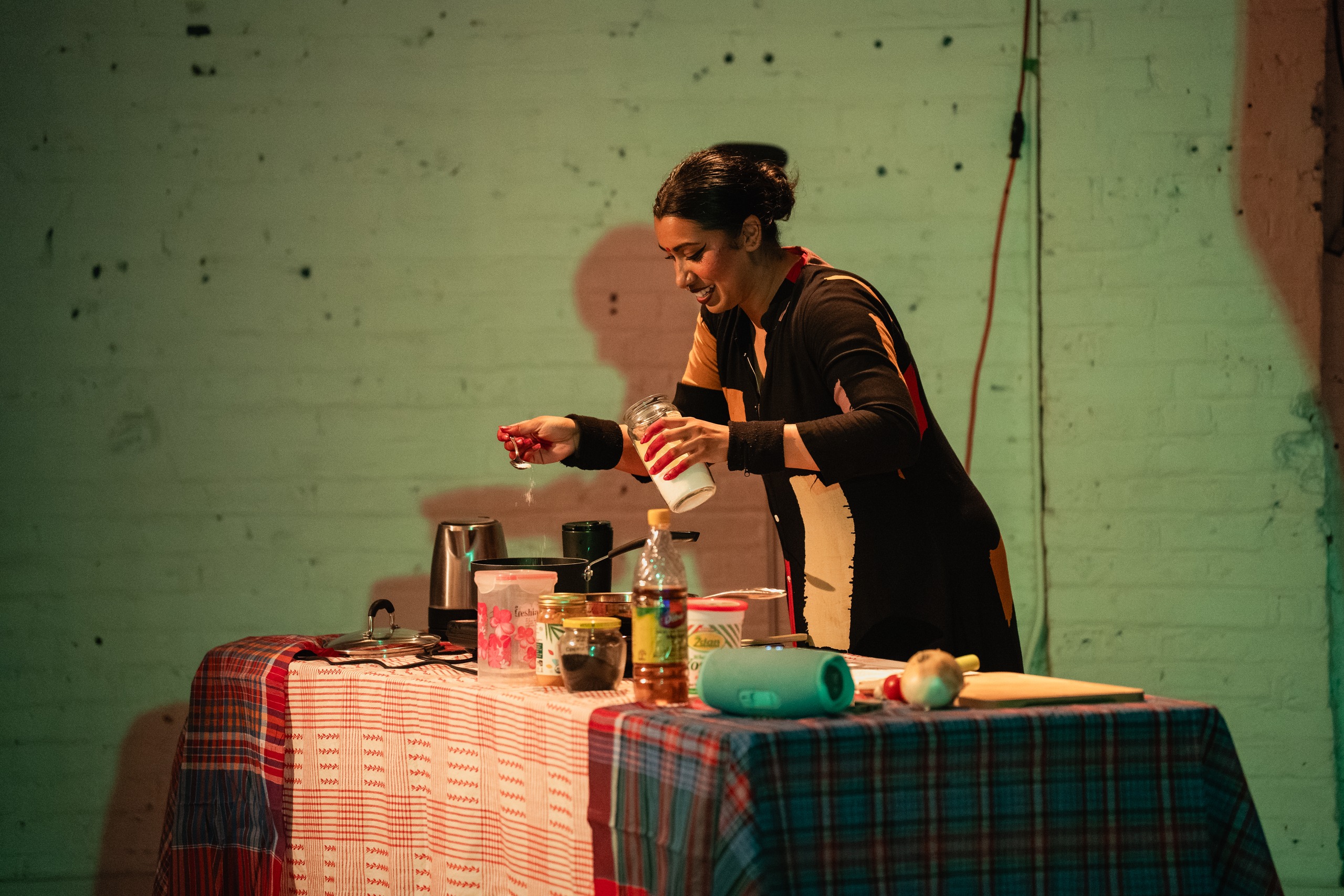
Tuli Bera performing “Bangali Meye.” Photo: Ricardo Adame.
By Daniel Johanson
The Chicago composer describes how shared recordings, wrist sensors and a performer’s growing confidence shape his movement-to-sound mappings.
“We recorded sound samples of washing rice, peeling onions, cutting eggplant, and frying veggies,” Scott Rubin wrote in an email interview.
Rubin, a Chicago composer, violist and interdisciplinary artist, builds sound environments that dancers can influence through movement. His account of making those connections begins with the sounds collaborators record together and follows what happens as a performer learns to work with them.
For Tuli Bera’s 2025 work Bangali Meye, Rubin said, the starting point was her relationship with Bangali food and its preparation. She invited him to dinner, and he brought recording equipment.
In Rubin’s description, the performance opened with Bera preparing food for the audience at an onstage table. They wanted to mix the acoustic sounds of her cooking with electronic sounds generated from sensors worn on her wrists.
“Cooking can be more in the fingers and less in the wrist where the sensor is positioned,” Rubin wrote. For those smaller movements to have a more expressive effect on the sound, he said, he would need a logarithmic approach to the mapping.
“For me, playable is about comfort with a certain level of confidence,” Rubin wrote of the confidence a dancer needs to play one of his movement-to-sound environments.
In those environments, Rubin doesn’t ask a dancer to control low-level musical information such as individual notes and rhythms while dancing. He explains the mapping and gives the performer control over broader musical qualities.
“Rather, I give them a rough explanation of how the mappings work, and I give them control of the articulation, density, and general energy,” he wrote.
That control develops through conversation and experimentation. Rubin said he asks about the project’s concept, the dancer’s movement language and their relationship with stillness before building an environment around those ideas.
“With every collaboration, there’s a moment during the exploration/improvisation phase when I see the dancer’s face light up,” he wrote. He describes the movement becoming more fluid as the dancer grows confident controlling the environment.
“The technology moves from being a focus of inquiry to becoming a natural amplification and recontextualization of the body,” Rubin wrote.
Asked whether one improvisation had changed the setup for a later performance, Rubin couldn’t name a specific moment. He described learning across years of work and an increasing interest in the mystery between a movement and the sound it produces.
He traces that interest to the snapping cloth of a karate uniform and, later, to playing viola while following different conductors. Both gave him ways to think about what a gesture communicates and what remains difficult to explain.
“My instrument might surprise me occasionally, but it’s within a given range of what’s possible,” he wrote of playing his viola, contrasting that familiarity with the mystery of a motion-sensor environment.
The motion-sensor environment raises a different question about mystery: what the audience can understand of the link between movement and sound. When deciding how to map movement for each project, Rubin considers what the audience can perceive.
“What will they understand, what will they feel, and what will they long to understand?” he asks.