
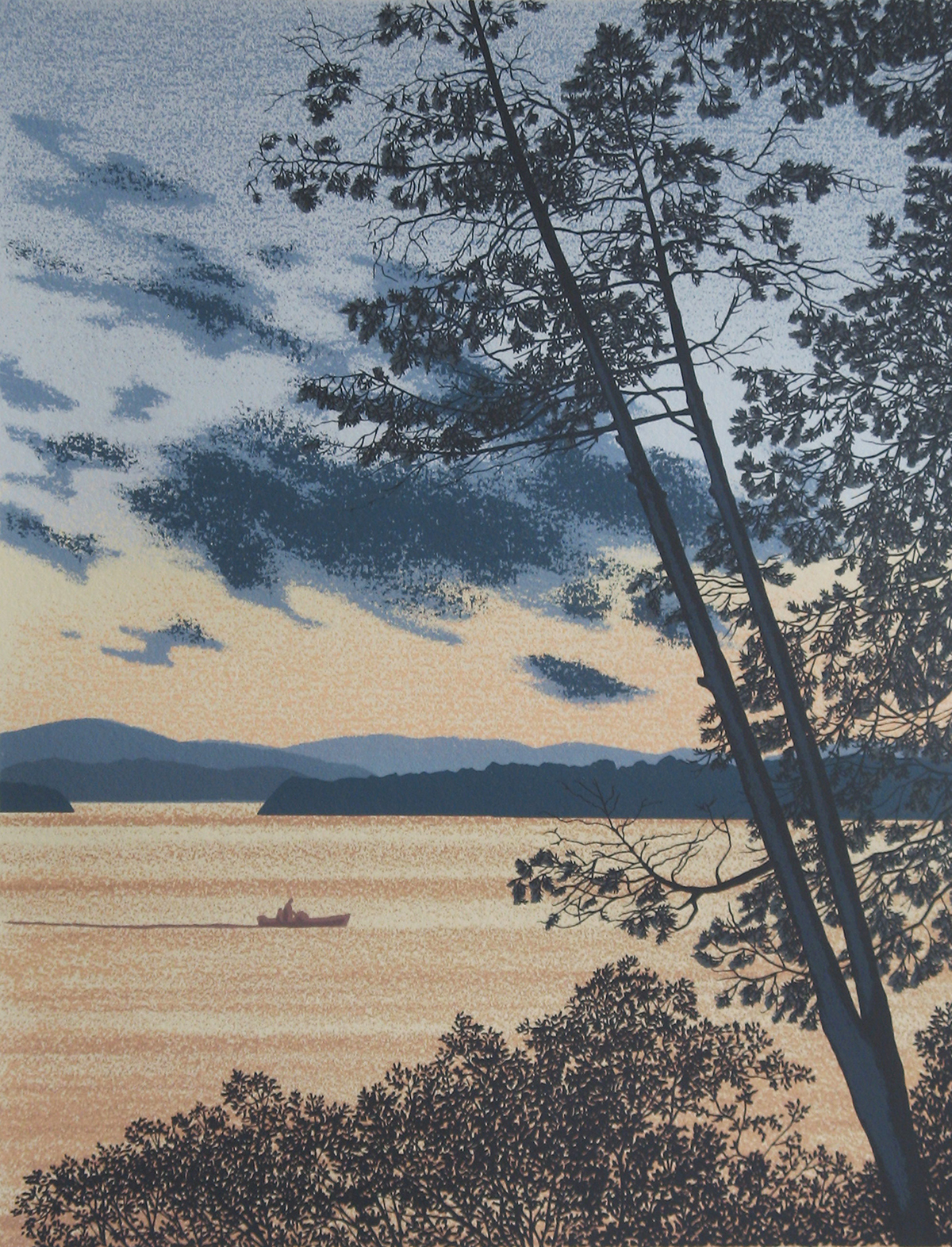
Tree House, a screen print by William Waitzman.
For William Waitzman’s Tree House, the first printed layer was a light blue rectangle that set the image’s borders.
“Then I printed a layer of slightly deeper blue, a crayon-y texture at the top of the sky,” Waitzman said in a written interview. “I went on to print yellow and orange in the lower part of the sky and proceeded to print additional layers until I completed the image, working from background to foreground, from big areas to details.”
“Screen printing is a stencil process. I start by making drawings in black ink, pencil or crayon, a separate drawing for each color I plan to print,” he said.
His drawings become stencils on fine-mesh screens. “Once the screens are made, I mix colors and I use a squeegee to drag ink across the screen to print the images onto paper.”
“But, unlike painting, the process is inherently very deliberate, and it can sometimes be challenging to translate my initial sketches and color studies into a finished print,” Waitzman said. “It does not always go as planned. Fortunately, nothing is locked in; revision is always a possibility.”
“I might, for example, carefully print a cloudy sky in several layers, only to decide it will not really work with what I have planned for the rest of the image. But I might find a use for that sky in a future print.”
“The same goes for other elements of a composition – a tree might turn out to not look quite right in its intended print, but I might use it elsewhere later,” he said. “Or I might redraw some parts of the tree and expose the image to a screen again.”
Some prints combine views of the same place at different times; others bring together more than one place. “I feel that my prints are about reflection, memory and time as much as they are about landscape because the process of making them is so time-consuming,” Waitzman said.
“And yet I want my prints to feel fresh, to not look as if they were labored over.”
“I ask myself what is it about this place that I want to convey, what mood or feeling, what qualities are important to the final image,” he said. “Sometimes that changes as the work is in progress, and I often make color adjustments or redraw parts of the image, changing or eliminating details, to arrive at a satisfactory result.”
“There’s no sense in investing a lot of time and energy into making a silkscreened image of a landscape unless I can make it my own somehow.”

Be First to Comment