
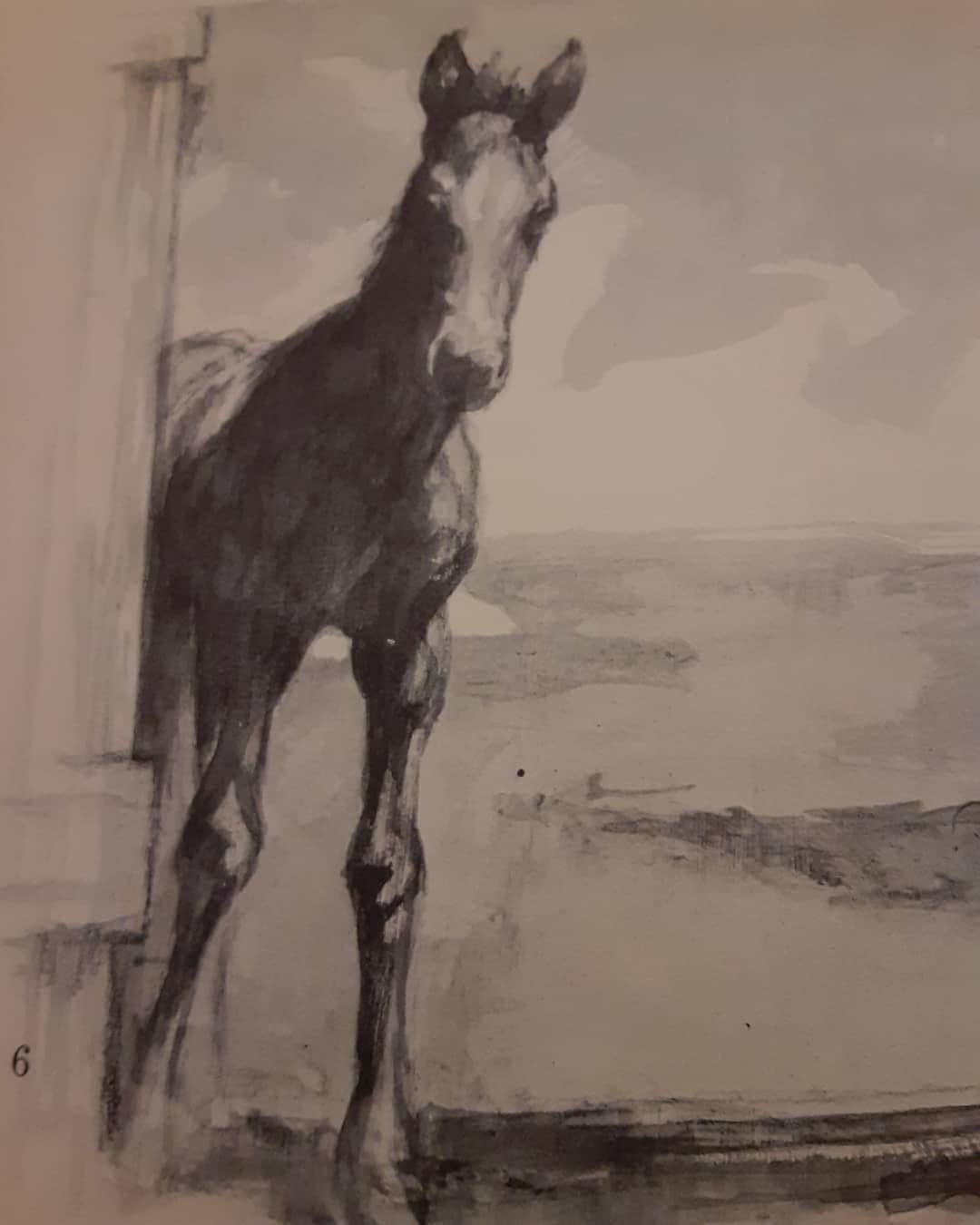
Illustration from The Nosy Colt. Illustration and photograph by Richard Lebenson.
Rochester embraces Jane beside an old tree in a sudden storm in one of Richard Lebenson’s illustrations for Jane Eyre. Lebenson uses that image to explain the emotional moment he looks for when making a picture from a story.
“When illustrating a story you try to pick moments that best tell the story, focal points with some emotional or visual impact,” Lebenson wrote in an email interview. “Sometimes the editor picks these, but usually it’s up to the artist.”
A building or a doorway can give him a different kind of starting point for a painting. He takes photographs as he walks, watching for light, shadow, reflections and textures that make a familiar place look newly interesting.
“When I pick a subject, it’s often something I’ve seen frequently and didn’t notice,” he wrote.
He described rust or another object becoming newly interesting in different light, and sometimes from a different angle. Fallen wet leaves on slate offer another example, their colors standing out as the surface dries around them. The subject may have been there before the moment he notices it.
“All of a sudden I not only look, but I see something extraordinary that I never noticed before,” Lebenson wrote.
Making the image gives that private discovery somewhere to go. “I find it very interesting as an artist to make it possible for someone to experience what I see and feel in that moment, in my art.”
The picture can keep changing while he works. “Taking advantage of mistakes or accidents, particularly in my etchings, is very important and exciting to me,” he wrote.
“Very often what I intend to do becomes something very different by the time I finish a piece,” Lebenson wrote. In an independent work, a change can become a direction to follow.
He described that freedom by saying that “in doing fine art, it’s very personal and you can go anywhere that the piece is taking you.” He described illustration as a collaborative effort with editors and art directors, while his own fine art practice is a personal, solo experience. An illustration also has the written story and an editor’s or art director’s approved sketch to answer to.
“Not a lot of room to improvise,” he wrote.
An editor can also use an existing fine-art piece as an illustration. Lebenson pointed to The Universe Makers as an example, in which the editor used one of his etchings.
The amount of room still depends on the text. A passage that fixes a character’s gesture demands a different response from a general description of people moving through a scene, he explained.
The embrace in Jane Eyre gives one picture its moment. On a walk, the light can supply another, and in an etching the next decision may come from something he had not planned.
