
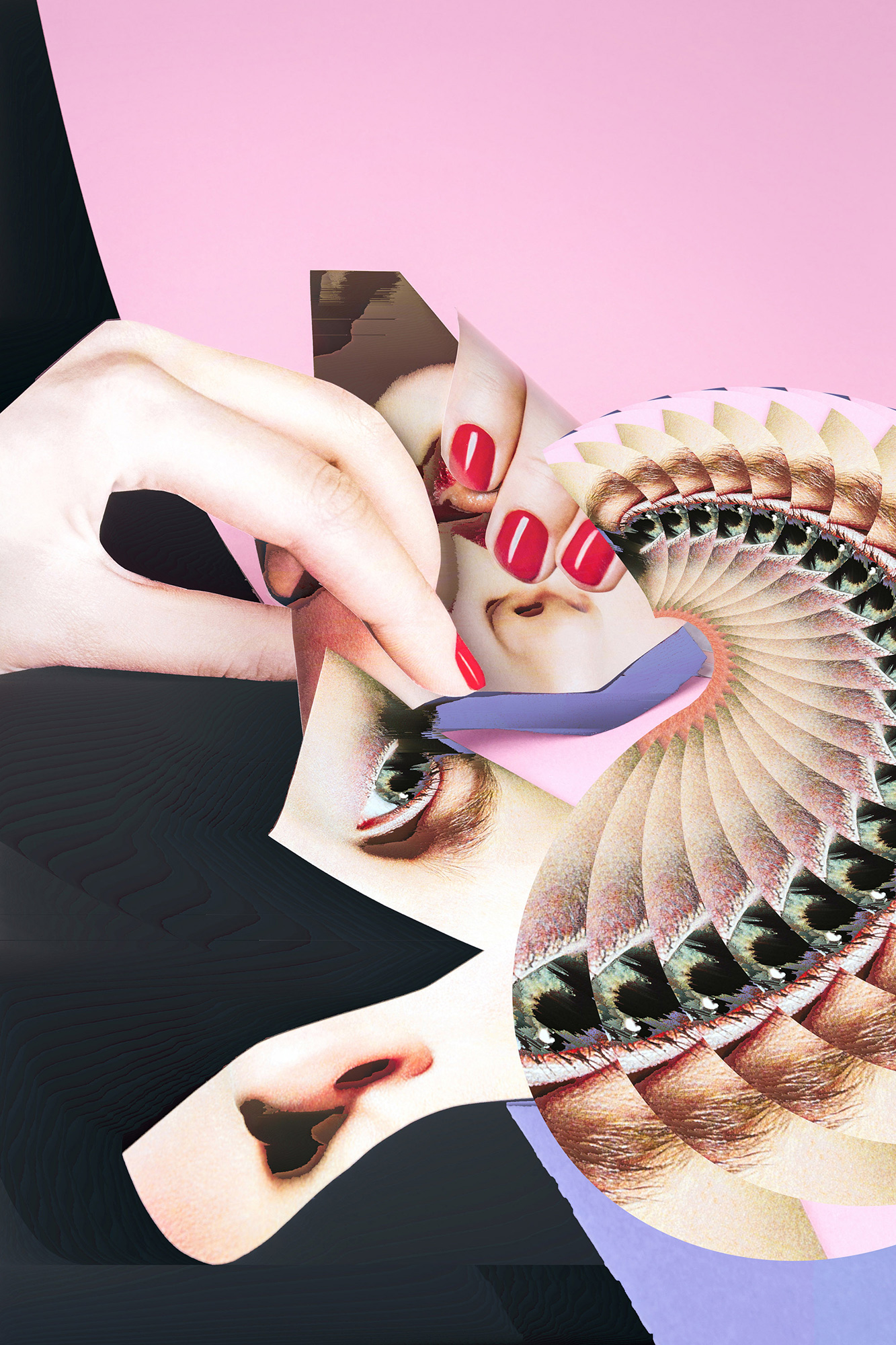
A hand with red nails holds fragments of a face in Ewa Doroszenko’s photographic series Body Editor. An eye repeats into a spiral, and the seams remain visible.
Ewa Doroszenko, Body Editor, photographic print on archival paper, 90 x 60 cm, 2018-2020. Image: Ewa Doroszenko.
“I do not retouch the error; I make it visible,” Doroszenko wrote in an email interview. Beauty apps promise a smooth, seamless image; she follows the point where that promise breaks down.
“On the print, I leave visible traces of processing, both analogue and digital, so the viewer sees not only the body but also the mechanism that constructs it,” she wrote.
The tight frame makes facial features look like parts that can be rearranged. The hand carries the familiarity of using a screen, bringing an ordinary editing gesture into the image itself.
“The hand is the gesture of an editor, close to the movement of fingers on a screen as we zoom, drag and adjust,” Doroszenko wrote. “The body ceases to be a person and becomes material for editing.”
She places that fragmentation in a longer history of images of women, referring to Hannah Höch’s photomontage and Alina Szapocznikow’s fragmented bodies. The attraction of the image remains part of the problem she is working through. She also names Ewa Partum, who treated the female body as a political field, and Teresa Pągowska, whose blurred figures elude a fixed identity.
“The error becomes a critical gesture, but also a fascination, because my relationship to images of female beauty has always been ambivalent,” she wrote.
In Radical Beauty, the picture moves repeatedly between a physical print and a digital file. Doroszenko intervenes in prints, scans them, makes collages and alters their surfaces before returning to digital manipulation.
“I keep the recognisability of the human face, because without it the deformation would not be legible,” she wrote. Enlarging eyes or changing proportions depends on viewers still being able to find a face in the result. The deformation also works as a feminist critique of beauty norms, one that proposes alternative visions of femininity.
Those moves between materials also let two kinds of control meet. “The analogue technique brings resistance, texture and chance,” Doroszenko wrote. “The digital technique offers precision and the possibility of endless correction.”
Where the finished image appears changes how those decisions register. “On a screen, a photographic image operates within the same ecosystem that I critique,” she wrote. A viewer scrolling through faces and filters may read the distortion as another effect in the stream.
The print asks for a different distance. “In an exhibition, photographic prints change the relationship between the viewer’s body and the image: one must step closer and see the traces of intervention, and the scale means that the deformation stops being a joke and becomes an experience,” Doroszenko wrote.
The difference stays unresolved when the work returns to a screen. “On a screen, this materiality disappears, and the boundary between my work and an actual filter becomes thin.” The visible error can expose the construction of an image, and it can still be mistaken for one more way to perfect it.

Be First to Comment