
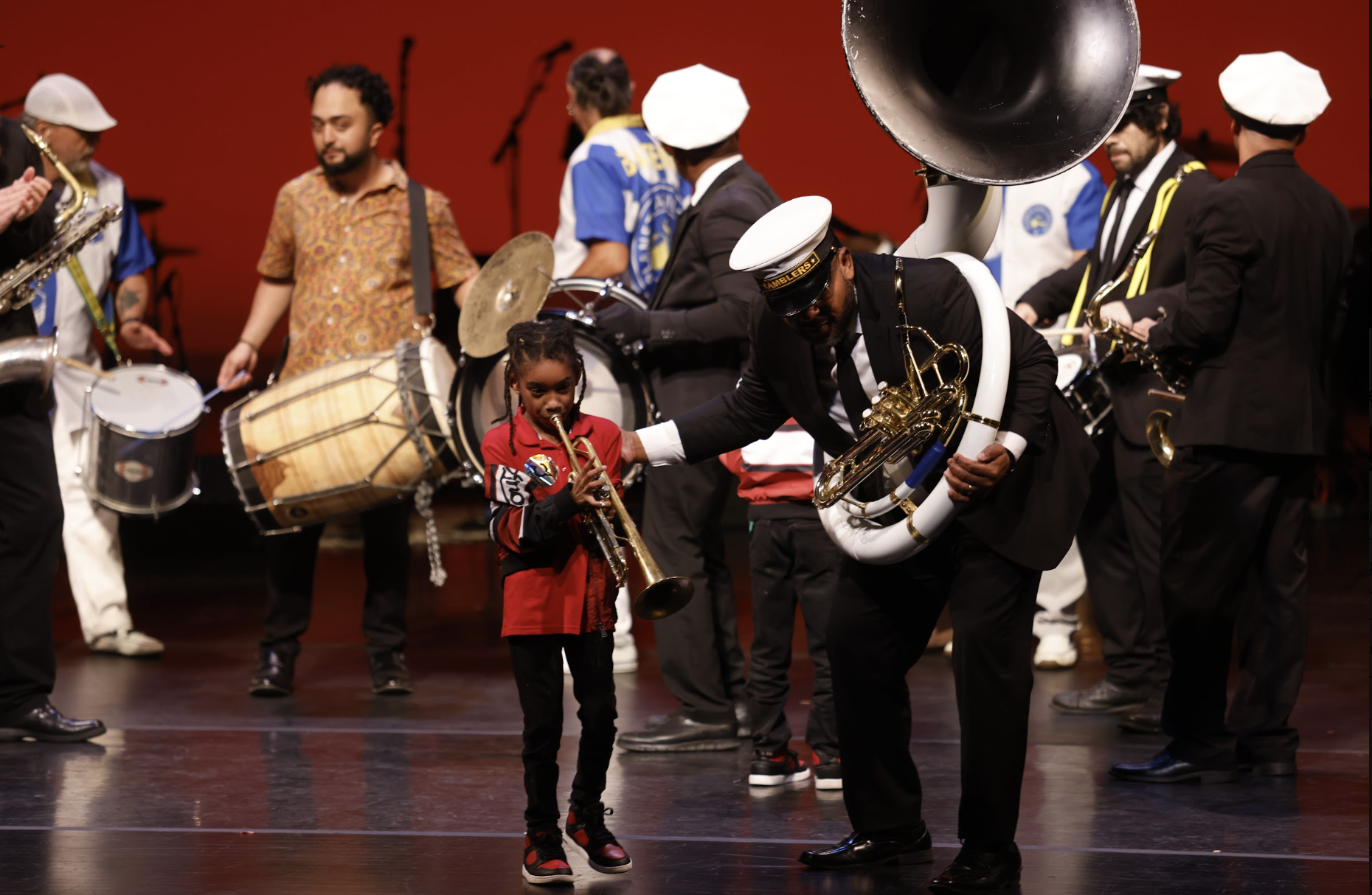
Windy City Ramblers at the Red Line Jazz Festival finale at the Harris Theater, October 16, 2026. Photo: Paul Araki Elliott.
At 95th/Dan Ryan, the Windy City Ramblers had to introduce themselves before a listener decided to keep walking. Trumpeter and bandleader Mario Abney chose the original composition “Rollin” to open the band’s October 1 performance for Mandala South Asian Performing Arts’ Red Line Jazz Project.
“In a station, you don’t get a warm-up with the audience; you get about ten seconds while somebody is deciding whether to keep walking,” Abney wrote in an email interview. “So the opener had to say who we are before the train came.”
The choice drew on Abney’s experience playing brass band music in New Orleans. “I chose it because it gets people moving,” Abney wrote. For a set inside a commute, the opening had to make its invitation audible immediately.
The station gave Abney several ways to see whether that invitation had landed. “Some people stopped and nodded their heads. Some people took videos, but some people just stood and watched,” Abney wrote.
Those listeners could arrive in the middle of a piece and leave for a train. The musicians had to play for the people who paused while keeping the music available to everyone passing through.
Produced by Mandala South Asian Performing Arts and curated by guitarist Fareed Haque, the Red Line Jazz Project brought free jazz performances to transit and community spaces across Chicago, culminating in the Red Line Jazz Festival at the Harris Theater on October 16, 2026. Moving indoors gave the organizers a different problem: a seated audience already knew it had come for a concert.
“At the stations, nobody bought a ticket or chose a seat,” Mandala Associate Executive Director Hiteshree Das wrote in comments supplied for the feature. “The music found people mid-commute, and they decided in a few seconds whether to stop.”
At the Harris, the organizers wanted to preserve some of that surprise. “So we didn’t open on the stage,” Das wrote.
“Windy City Ramblers, Butter Chicken Brass Band, and Luciano Antonio’s group marched in through the aisles, loud and unannounced, at the moment people least expected it.” Das said the three groups met in the middle of the house and improvised together.
Das connected that entrance to the baraat, the South Asian wedding procession in which a marching band accompanies the groom through the streets. “The baraat doesn’t wait for an audience to arrive. It moves through the city and brings everyone along,” Das wrote.
For Abney, the theater changed the audience’s energy, and playing there was an honor. The move also gave the Ramblers something specific to carry over from the station.
“What we wanted to keep from 95th/Dan Ryan was that second-line energy and the feeling that the music is for everybody in the room, not just the people who came to sit and listen,” Abney wrote.
The aisle entrance gave that intention a route through the theater. Before the audience could settle into watching a stage, the music was moving among them.

Be First to Comment