
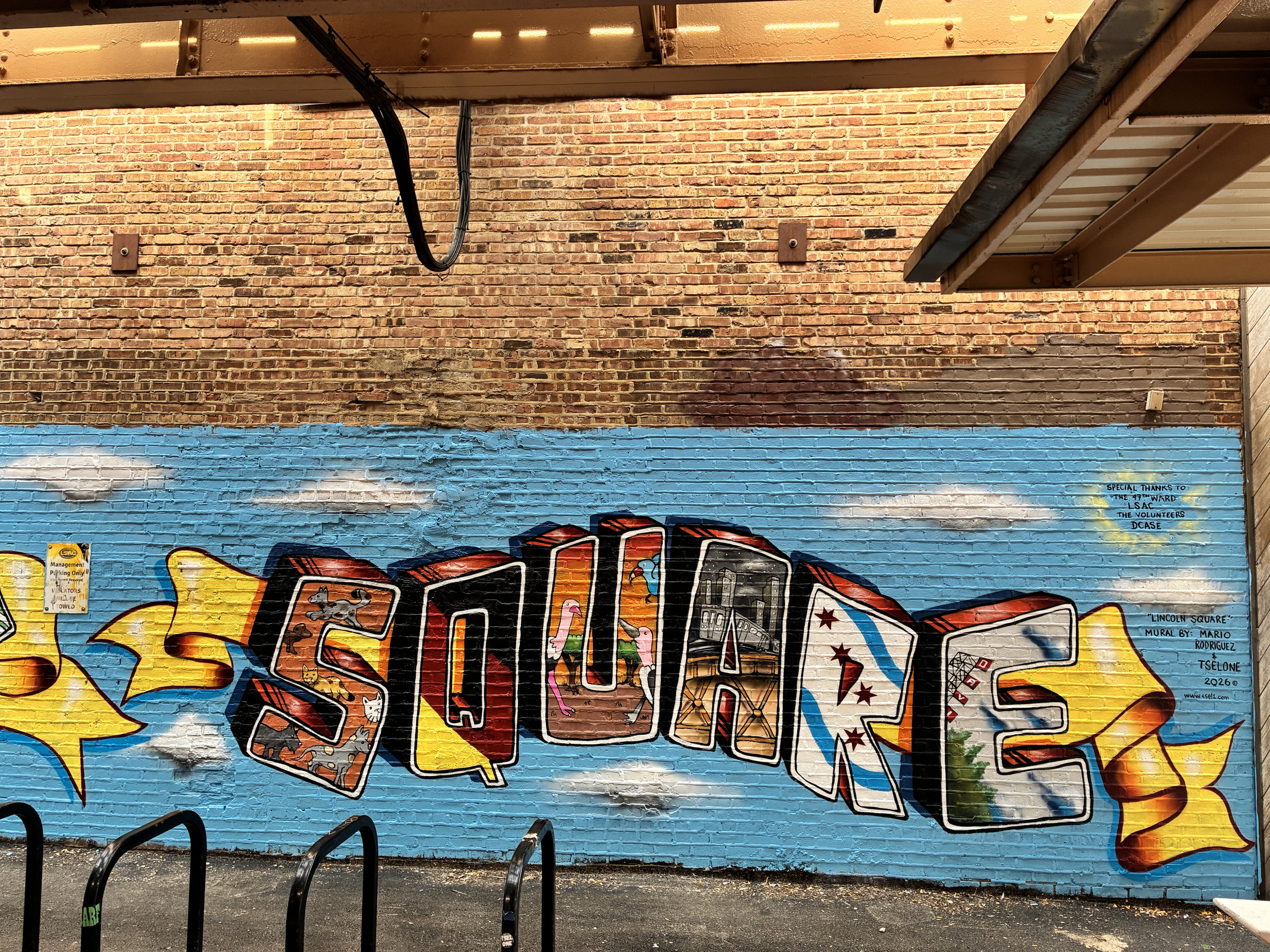
Section of the Lincoln Square mural in Chicago’s Lincoln Square neighborhood, 2026. Mural by Nino Rodriguez and Mario Rodriguez, with community volunteers. Photo: Debra Levinthal.
Nino Rodriguez asks a student to write a plain letter T. The next step is to draw a thicker outline around it, then another layer, until that familiar letter begins to take on a shape the student can call their own.
“The T would be the bone and now I explain that they will be adding skin to the letter,” Rodriguez wrote in an email interview about the exercise he calls the “bone and skin” method.
Rodriguez, the Chicago artist known as Tsel One, began painting graffiti in 1984. He describes learning from the art and photographs in Subway Art, studying other artists’ lettering and practicing before developing his own style.
“After decades painting graffiti art, I began to use my own methods to teach others how to create graffiti style lettering,” Rodriguez wrote.
The simple first letter gives a student something to build on. Each new outline can change its proportions, and Rodriguez expects the result to differ from one person to another.
“This is where their own style comes into play, because no two artists will create the same simple letter and no two artists will outline it the same way,” he wrote.
Once the outline has developed, the student can erase the original letter and look at what the layers have made. Rodriguez also uses a name such as TSEL to show how the same exercise can extend across several letters.
That approach to a manageable first mark carries into his account of the Lincoln Square mural, made with his son Mario Rodriguez and community volunteers. Many participants were painting a large mural for the first time.
“I wanted people to first feel comfortable painting, I did not want them to feel pressure, so I had them paint parts that were not detailed, complex, nor had them mix colors on the walls,” Rodriguez wrote.
After the outline was complete, he selected areas where he thought participants could work comfortably with brushes and spray paint. If someone worried about making a mistake, he could offer a practical answer.
“All art can be fixed, repainted or changed,” Rodriguez wrote.
“I always want people to feel that this is their art too and their contributions are rewarding to the completion of the entire mural,” he added.
The letters also carry details of the neighborhood around the wall. Rodriguez points to the Chicago flag in the R of Square, and the CTA Brown Line inside the A, with the train itself passing above the mural.
“People getting off the cta train can see the very thing that brings them home in this mural,” Rodriguez wrote.
The lettering exercise begins with a shape a student recognizes. At Lincoln Square, the finished letters return that recognition to the people moving through the neighborhood.
“But I do want people/Chicagoans to learn that my son and I created this mural in their honor, this mural was made and created with them in mind,” Rodriguez wrote.

Be First to Comment