
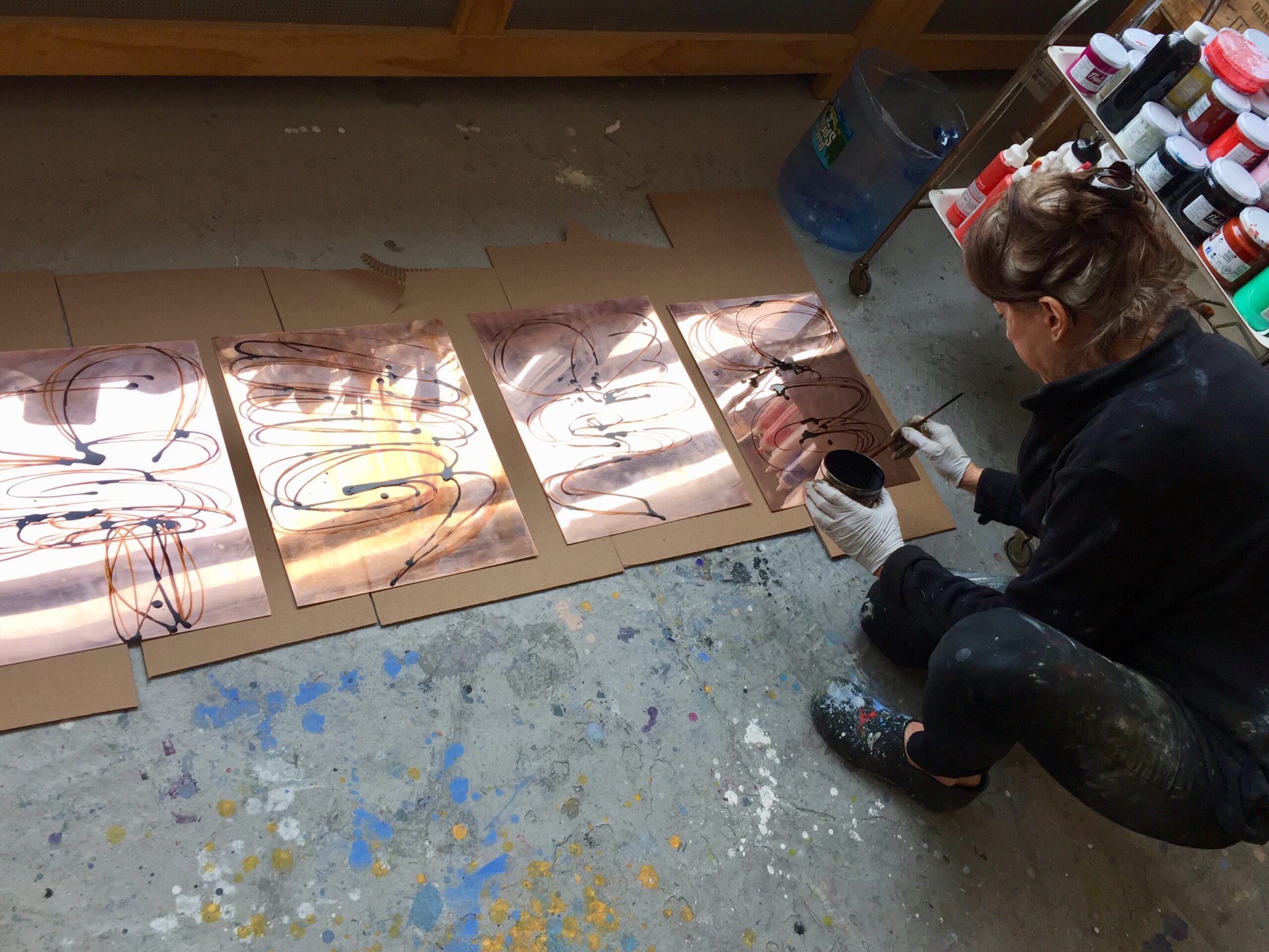
Six copper plates went into a suitcase when Jonathan Higgins and Jill Moser needed to start again. Their first week working together on a multicolor etching had ended with a result neither wanted to pursue.
Jill Moser working on the Chroma Six plates in her studio in Long Island City, New York, Feb. 27, 2019. Photo: Jonathan Higgins.
“We decided to scrap our initial efforts and start over with a new approach,” Higgins wrote in an email interview about Manneken Press. Several months later, Moser showed him a new group of paintings, and he saw another way into the prints.
“I packed six copper plates and some materials into a suitcase and flew out to NYC,” he wrote. Moser put the initial forms onto the plates in her own studio; Higgins brought them back to Manneken for etching.
The work continued across that distance. “The rest of the project unfolded remotely, using extensive FaceTime calls and emails to talk about color, and Fedex to send proofs back and forth.” The resulting 2019 suite, Chroma Six, consists of six color aquatints, each in an edition of 20.
Higgins said that experience of collaborating with an artist remotely gave him a way to keep working months later, when artists could no longer visit the studio during the pandemic.
A more recent collaboration with Catherine Howe opened another question about what an edition could do. Higgins described Howe making colorful, gestural monotypes, then becoming curious about producing an edition.
“I prepared some copper plates and encouraged her to use sugar lift, a technique that can be used to obtain painterly marks in aquatint,” he wrote. Howe made three plates, each carrying a single flower form. “I etched and printed the aquatints in black ink on white paper.”
The black-and-white impressions offered a different reading of those gestures- silhouetted and very graphic- and they decided to develop this idea into a larger group. In his November answers, Higgins said Howe was busy making more plates in her home studio for him to etch and print.
“We have yet to decide if they will remain monochromatic or to try adding an element of color,” he wrote.
That willingness to leave a decision open is one part of the job. A print starts with an artist working on a plate, block or stone that will carry an image onto paper, and the proofing stage allows different versions to be tried.
“In addition to working closely with the artist to develop a print, another of my roles is as the printer of the edition,” Higgins wrote. “Each print that makes up an edition is considered an original work that exists as a multiple.”
Once the image is settled, the task changes from finding possibilities to making the edition consistent. “These are almost opposite roles; one being open to all possibilities to help realize the artist’s vision, the other being as exacting, precise and regulated as possible in order to print a consistent edition of the image,” he wrote.
The copper plates in the suitcase belonged to the searching part of that work. Printing the edition asks Higgins to preserve the decisions that the search made possible.

Be First to Comment