
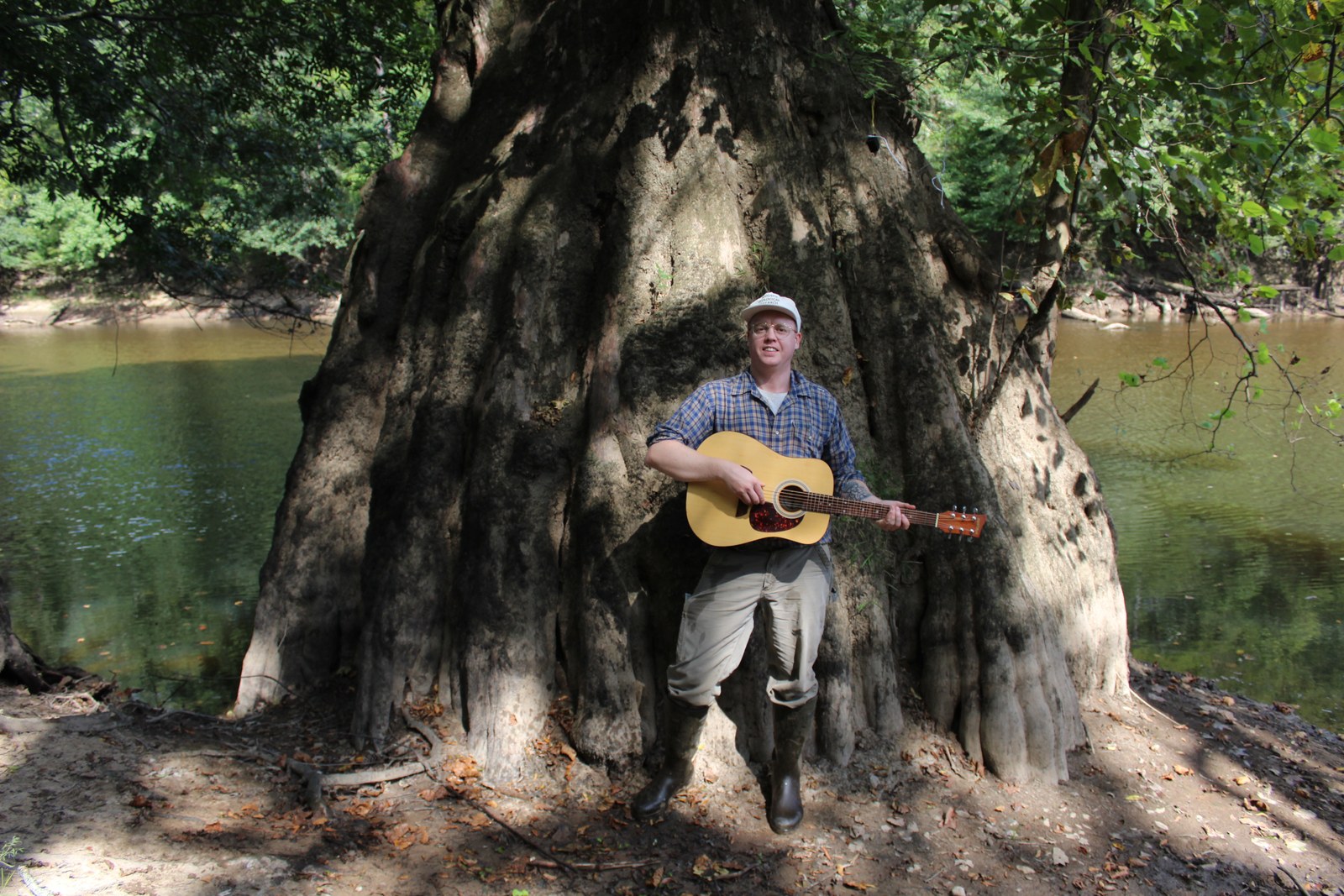
Featured image: Daniel Bachman. Courtesy of Daniel Bachman.
For one track on The Witness Tree, Daniel Bachman says he sat beside a dogwood, listened to its sonified data and tuned his guitar to the notes he heard. Other locations were too loud or public to work that way, so the place helped determine how a recording could be made.
“It would have a couple minutes of busier notes, settle down, and I just tried to accompany those sounds as best I could,” he wrote in an email interview.
The Witness Tree, released October 2, 2026, pairs an album with a documentary film. Bachman’s project notes describe using a biodata-sonification device built by artist and engineer Sam Cusumano with 16 trees in Virginia.
The notes connect those locations with histories of settler colonialism, racial hierarchy, extraction and climate breakdown. Sonification is a way of making data audible; the device and Bachman’s musical decisions mediate what a listener hears.
“For every track on The Witness Tree I tried to be true to the events that the trees had either lived through, or were currently living through at that moment,” Bachman wrote.
That didn’t mean using one musical technique for every location. He described accelerating distorted drones as an abstract representation of sea-level rise and a more literal approach to the fire associated with American Boxwood Barboursville Ruins.
Virginia’s Department of Historic Resources records the destruction of James Barbour’s home by fire on Christmas Day, 1884. Bachman said he used leaves from historic oaks at the site inside a guitar, combined that sound with recordings associated with the boxwoods and ended by recording the leaf-filled guitar burning with a contact microphone attached.
The fire is his account of a recording process, not a scene witnessed for this article. In it, a choice of sound-making material connects the track to the event being represented.
The dogwood recording offered a different relationship to time. Bachman said the site for Dogwood Mountain Valley Pipeline Blast Zone was quiet enough to stay beside the tree and listen.
“So it was really with the trees that I was able to sit for an hour or so and listen, tune my guitar to them, and listen more, that I really got my favorite results,” he wrote.
The project’s historical sources also include the work of his grandmother, Mary Hostetler Oakey. Bachman said she worked at Lorton Reformatory, helping facilitate furloughs through which incarcerated people could take part in community work, college and performing arts.
For the track listed on the album as Eastern Red Cedar Stoney Lonesome Cemetery Occoquan Workhouse, he described combining her words with text by formerly incarcerated historian and filmmaker Karim Mowatt. The album’s process notes separately describe using text-to-binary-to-MIDI synthesis to embed historical material.
“It’s a little tribute to her,” Bachman wrote.
He also said his documentary includes interviews with Tyrone Parker and Roach Brown, two men who had been incarcerated at Lorton and knew his grandmother. His description places her work alongside people with their own experience of the institution.
The tree recordings, environmental sound and historical texts aren’t interchangeable material. Bachman’s account of the dogwood makes that particularly clear: when the location allowed him to stay and listen, he let its changing notes determine how he accompanied them.

Be First to Comment