
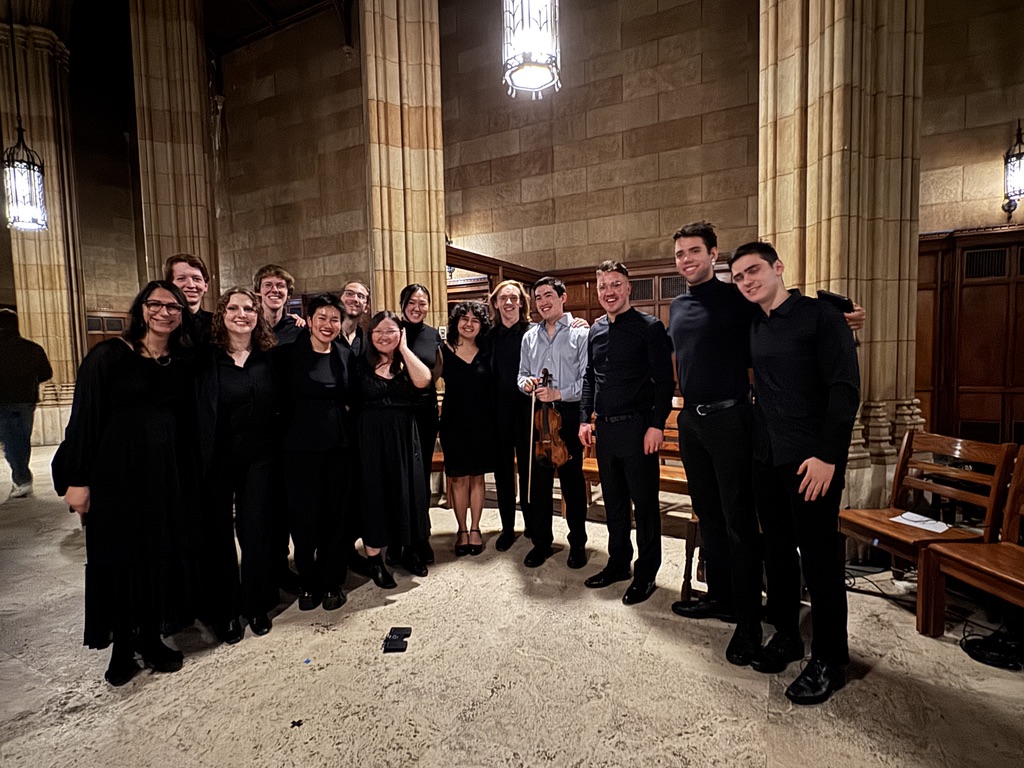
Featured photograph: SOLACE singers with conductor Caspar Wein and composer and soloist Atticus Margulis-Ohnuma. Photograph by Mary Margulis-Ohnuma.
At the beginning of SOLACE, Atticus Margulis-Ohnuma wanted listeners to have trouble locating the sounds around them. By a later passage, he wanted them to be able to follow a violin’s echoes as they moved through the same circular space.
“The circular layout was thematically important throughout the work,” the composer and violinist wrote in an email interview.
Yale’s production record places the performance at Dwight Chapel on April 1, 2025, and describes a work combining choral voices, violin, electronic processing, lighting and projections. Margulis-Ohnuma’s answers explain how the room entered the composition.
“In early parts of the piece, consonants in the singers’ parts bounce around the circle in specific patterns, causing disorientation for the audience,” he wrote.
“Presented in the dark, in an extremely resonant chapel, it was hard to tell where these sounds would come from and where they were going,” he wrote.
In a later piece, A Vast Expanse, he said, an electric violin connects to a speaker array arranged in a circle behind the audience. A circular delay moves the plucked notes around the room.
“The circular delay was difficult to create, as we wanted the echoed sounds to move smoothly around the room in a way the audience could track,” Margulis-Ohnuma wrote.
The difference between disorientation and a pattern someone can follow was deliberate. He said the audience had become familiar with moving sound by that point, and the later effect was intended to let them feel the music swirl around them.
The four-chapter structure gave the listener another recurring element. Each chapter contains one movement of solo Bach, Margulis-Ohnuma said, with the other works taking inspiration from it and sharing its key.
“Each chapter builds thematically and sonically on the previous chapters, however the movements of solo Bach remained unaltered, preserving a sonic and stylistic through-line for the work,” he wrote.
Bach remained recognizable while the surrounding material developed. The spatial effects could change the listener’s bearings without removing every point of continuity.
Margulis-Ohnuma said he wanted SOLACE to be both personal and universal, but he didn’t know in advance how the experience would reach an audience.
“I spent a long time agonizing over each element of the experience: I knew it was powerful, but I didn’t really know if it would really work until the performance,” he wrote.
He described feeling the audience engage during the performance and hearing afterward from people about its personal impact. Those responses are his account, rather than a substitute for testimony from individual listeners.
The compositional decision is concrete even when its result is personal. Early in SOLACE, a sound’s origin could be hard to place; later, the circle offered a path to follow.

Be First to Comment