
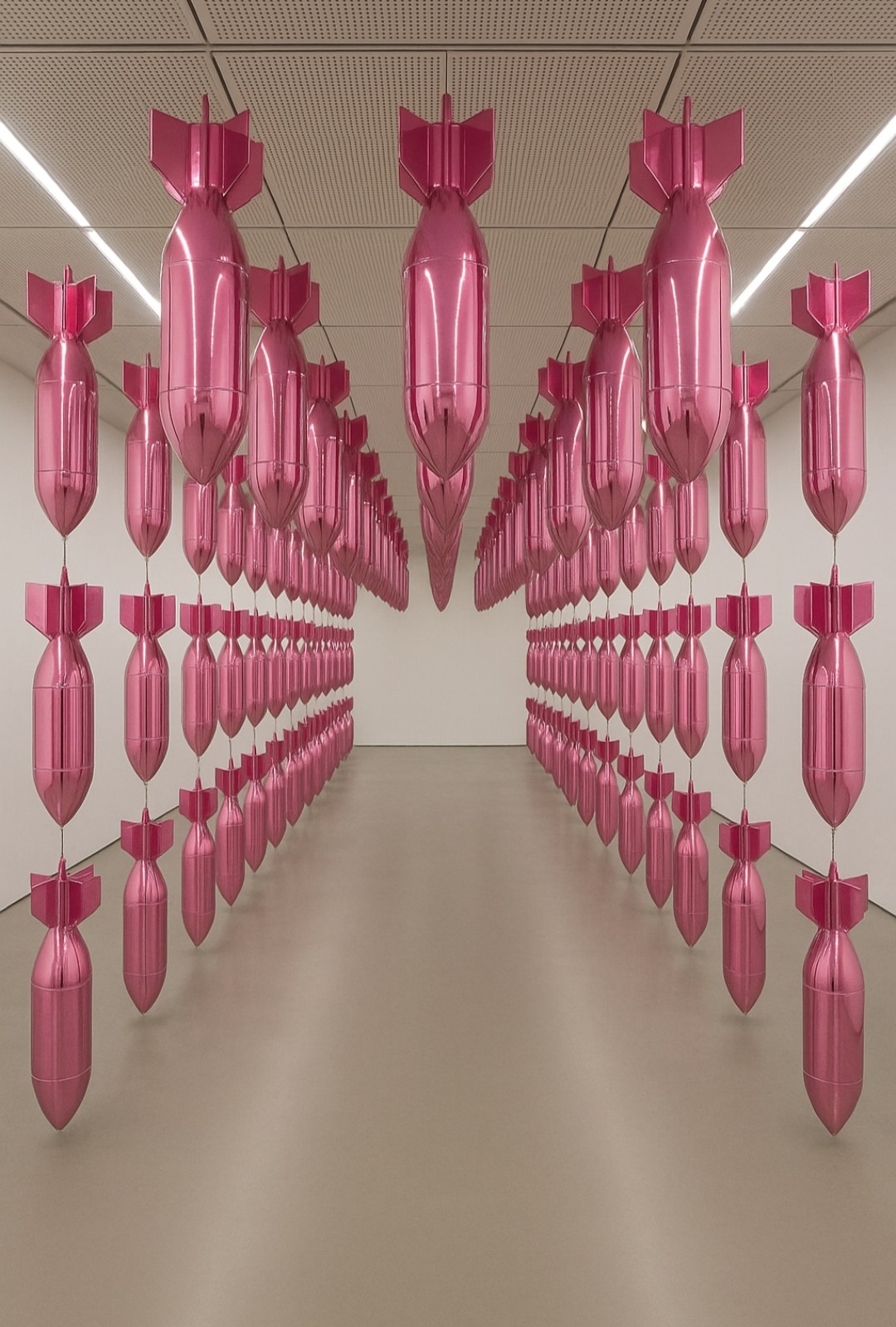
Featured image: Skin in the Game, 2026, from the ongoing Spring series. Installation with inflatable bomb-shaped balloons. Credit: Sara Rahanjam.
“I began creating colorful, meticulously crafted sculptures of bombs, grenades, and military weaponry,” Sara Rahanjam said in an email interview with Scapi. She was describing Spring, an ongoing series she said she began in 2012 while following wars in the Middle East and Syria through news and media.
Rahanjam is an Iranian artist living and working in Iran, temporarily residing in Germany for a one-year art fellowship. She said she came to Chicago in 2023 for a group exhibition of Iranian women artists and currently works with Kavi Gupta Gallery in the city.
The contradiction she was trying to make visible involved the language used to justify destruction.
“The work was born out of a critical observation: how global power structures often operate under the rhetoric of ‘salvation’ and ‘bringing peace,’ yet justify mass destruction, bloodshed, and the loss of thousands of innocent lives to achieve it—a stark contradiction to the true meaning of peace,” she said.
As the series continued, that starting point changed. Rahanjam said war reached her home country, Iran, in June 2025 amid conflict involving Iran, Israel and the United States.
“When war ultimately reached my own home country last year, what was once observed from a distance became an immediate, tangible reality, driving me to continue developing the series with even greater emotional urgency and direct personal resonance,” she wrote.
That change raises a question about the work itself: how does the emotional pressure of an experience become a form someone else can enter? Rahanjam’s account of making begins with time spent reading.
“My process always begins with a prolonged period of research and mental gestation,” she said. “When an issue deeply affects me, I spend weeks or even months reading and studying to expand my understanding.”
“I don’t force the visual form; instead, I allow it to synthesize and emerge organically in my mind over time,” she said.
Speaking about her practice more broadly, Rahanjam named bronze, fiberglass and textiles among the materials she returns to. Her answer connects those choices to what a piece needs to communicate.
“For me, material is intrinsically bound to the concept—as the form takes shape in my mind, the corresponding material reveals itself as an essential carrier of meaning,” she said.
That connection remains open to revision during making. Even a completed sculpture can send her back to the idea.
“Often, after bringing a piece to completion, I realize it no longer serves the essence of the concept,” she said. “I have completely destroyed finished works right before exhibiting them, letting them go to move on to the next iteration.”
“This act of letting go and starting over isn’t a loss; it is precisely how the core idea clarifies itself, constantly reshaping my understanding of what the artwork truly needs to communicate,” she said.
What survives that process still meets a viewer with a different history. Asked what someone might discover without knowing the personal story behind a piece, Rahanjam described both recognition and surprise.
“Yet, what has consistently amazed me is how often viewers connect directly with the exact core idea I was reflecting on—even when I haven’t made any explicit reference to it in the work’s title or statement,” she said.
The response can also take the work somewhere she hadn’t anticipated.
“At the same time, there are many instances where viewers discover completely new perspectives in the piece that I hadn’t consciously thought of, which is a natural and rewarding part of artistic reception,” she said.
For Rahanjam, the idea has to survive choices about form, material and whether a finished work should survive at all. Once the sculpture reaches a viewer, its maker’s experience leaves room for another person’s.
“In principle, an artwork carries multiple layers of meaning, and every viewer interprets it through the lens of their own personal experiences and lived reality,” she said.
Explore Sara Rahanjam’s work on her website.

Be First to Comment