
A director can bring playlists, furniture images and an early reading of a play into the first production meeting. At Idle Muse Theatre Company, that material gives the designers something to answer.
“Initial production meetings usually kick off with the director's presentation of concept material, which is not prescriptive but defines an early direction,” artistic director Evan Jackson wrote in an email interview with Scapi Magazine.
“The design and production team, in turn, is asked to respond in the next meeting with their own presentation of material to crash together with the director's,” he wrote.
“The design of the show is essentially born out of the intersection of all those ideas.”
The starting material includes a reading of the play's themes and images of fashion, architecture and light. Each collaborator has a direction to respond to, and the next meeting brings another set of choices into the room.
Jackson described how that exchange can continue inside a scene. His example was a campfire in The Last Queen of Camelot, an original adaptation he had written.
“The most beautiful scene I ever directed was a campfire scene in The Last Queen of Camelot that light and sound had kicked off with a perfectly constructed tableau of Arthur's court,” he wrote.
Jackson had included moments that would matter later in the plot, along with a song and some teasing of Lancelot. The staging also left some actors with quiet time around the fire.
“The way the action played out, though, left some characters with a bit of quiet downtime around the fire, in which a couple of improv-trained individuals started playing with Spolin focuses, like progressive intoxication and shows of affection that established relationships,” Jackson wrote.
“Eventually ad libbed lines started emerging from this and an entire shared history unfolded.”
“It was the last good night together, in a consciously designed peaceful space, before the fall of a tribe that loved each other more than they could say out loud,” he wrote.
The scene gave Jackson a specific example of what rehearsal could add to a script. He also described the difficulty of setting aside an idea after someone has worked to bring it that far.
“These can be tough conversations because if an idea has made it to the rehearsal stage, it means someone has put thought and inspired effort into it,” he wrote.
Jackson invoked George C. Wolfe's idea about whether a choice serves the play or distracts from it. He looks for the point when, as he put it, “making something work has become too heavy to sustain or no longer moves the telling of the story forward.”
The campfire scene left him with something he could carry into the text itself. The relationships and lines the actors developed in rehearsal became part of his written version.
“I've now written every part of it into the publication draft,” Jackson wrote.
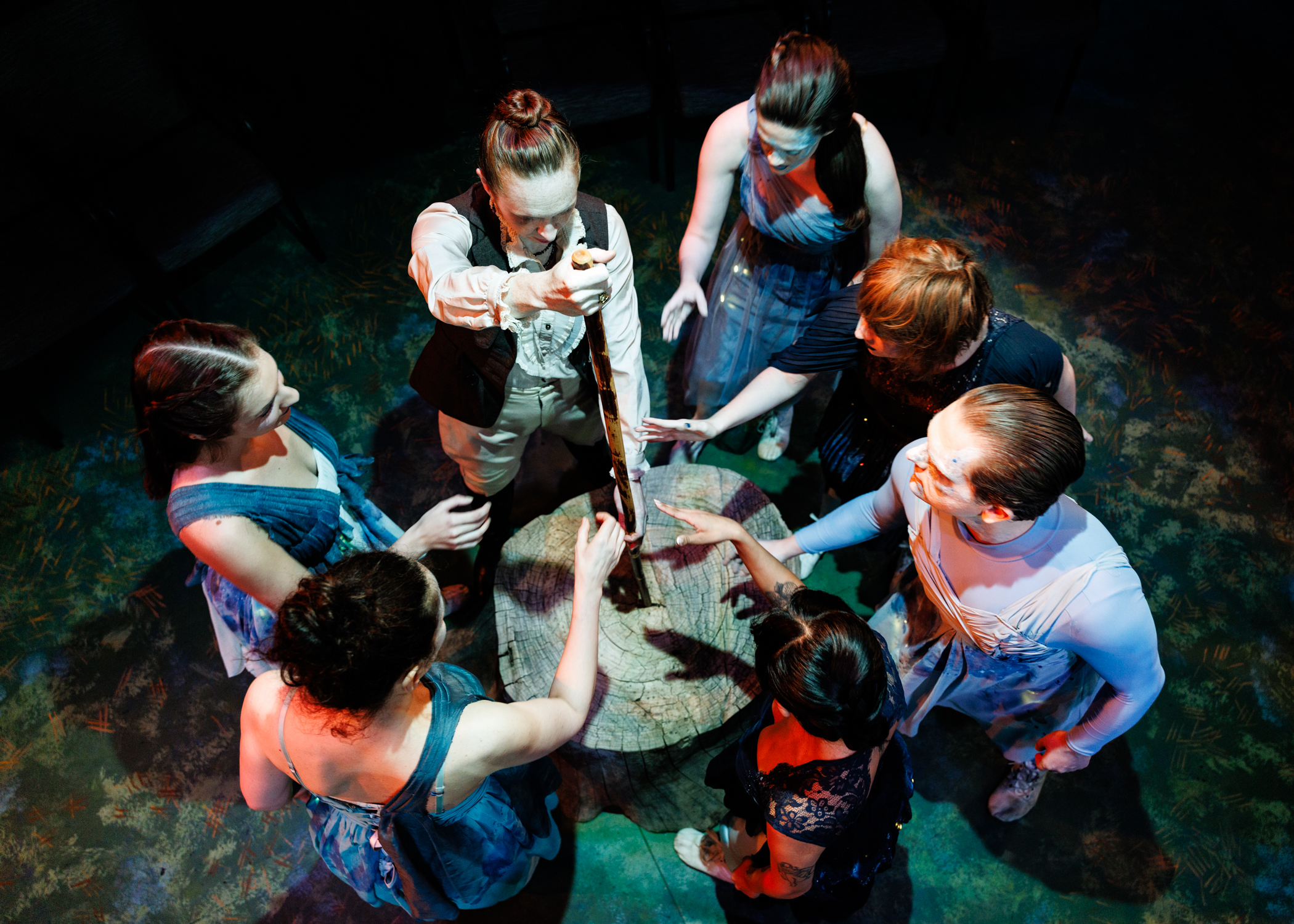
Idle Muse Theatre Company’s The Tempest, archival photograph, 2024. Photo by Steven Townshend, Distant Era.
