
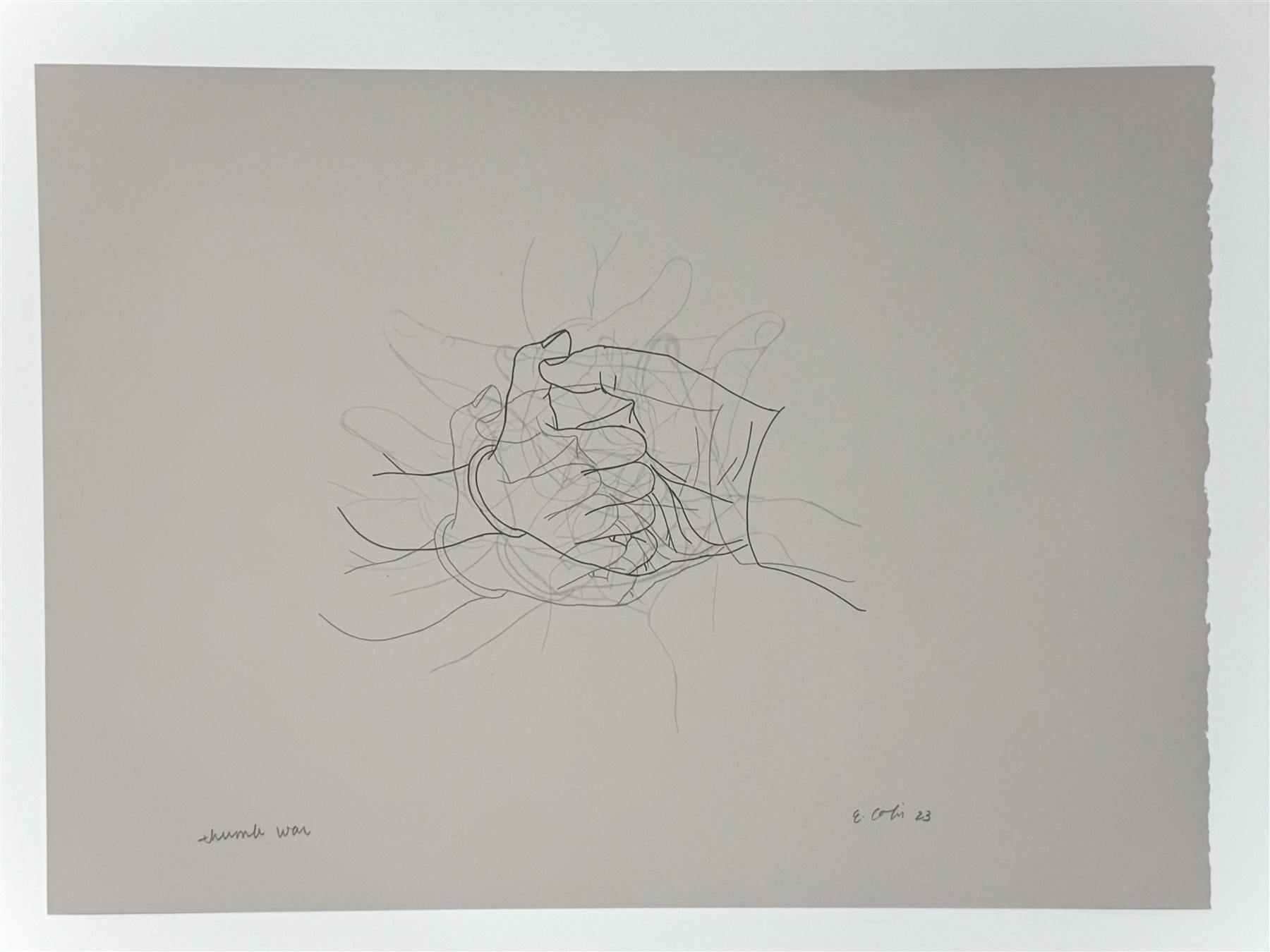
Pictured above: thumb war, a one-of-a-kind silkscreen on Stonehenge paper by Eileen Brodaski of Ainslie Street Prints. Artwork and image courtesy of the artist.
An edition can give an image a wider life. It can also give an artist a way to support the people around her. For Eileen Brodaski of Ainslie Street Prints, those possibilities begin with a practical difference: sometimes she starts with an idea she wants to reproduce, and sometimes printing is how she discovers what the idea might become.
Brodaski’s Ainslie Street Prints is holding a fall pop-up market from noon to 6 p.m. Saturday, Oct. 24, at 2449 W. Ainslie St. in Chicago, according to the flyer she supplied.
In written answers to Scapi Magazine, Brodaski described printmaking’s ability to produce multiples as a way to make individual works more affordable while helping cover the time, materials and experience involved in making them.
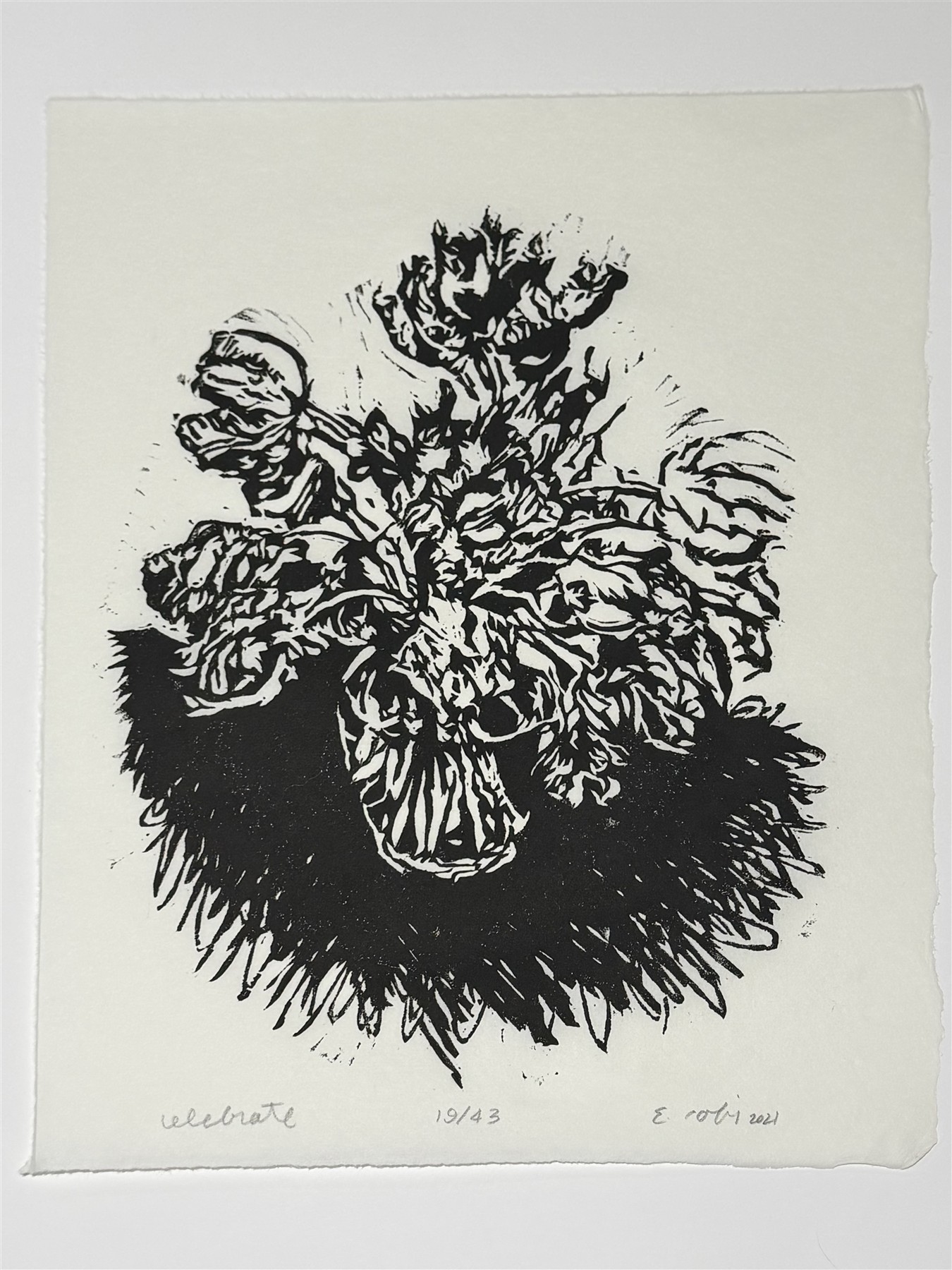
The decision to produce an edition depends on the subject, the process and the concept she is working through. During the pandemic, she made linocuts with one-word titles such as “restore,” “refill” and “celebrate.” She committed to spending the proceeds within her community, at locally owned or small businesses.
The images were responses to what she encountered around her, from news stories to her own uncertainty about life in the city. Printing an edition by hand after her children went to bed gave that anxious energy somewhere to go. In those works, she said, the concept could be held within a single reproducible image.
Another body of work developed through a less settled process. Sitting on the couch with her son, Brodaski noticed him slip his hand into hers and wondered whether it might be the last time he wanted to hold it. She took a photograph and began drawing their hands for a silkscreen.
The image led to more images: her own hands, her daughter’s hands, and the two of them playing a thumb war. Rather than carrying out a finished plan, she began using the screen to explore what those gestures could mean.
For the silkscreens, multiple images shared a screen. Brodaski varied their layers, colors and compositions, letting each pull suggest another decision. Repeating the image could produce an expected result or open a different way of seeing it. One image on a sheet of paper could say something different from fifteen.
A separate group of monotypes, made as gifts for the people celebrating her wedding, gave her another way to think about relationships among prints. Working with ink on plexiglass, acetate shapes and a set palette, she varied a limited group of components. Each finished piece became its own combination.
“A community or family of prints instead of an edition,” she wrote.

That distinction connects the process in the studio to the people who might encounter the work. Brodaski sees the viewer as part of the art, rather than as someone who arrives after the creative decisions are complete. A piece can connect an artist to a viewer, viewers to one another, or the person an artist was before making it to the person she becomes through the process.
Her hope is that an experience explored through an image can help another person recognize something of their own. The work begins with a particular set of hands, an object or a feeling, then becomes available for someone else to understand differently.
Making art in and for a community, she said, gives her a way to share both the things she struggles with and what helps her move through them. Repetition is one tool in that work. It can carry a finished thought further, or give a new thought room to develop.

Be First to Comment